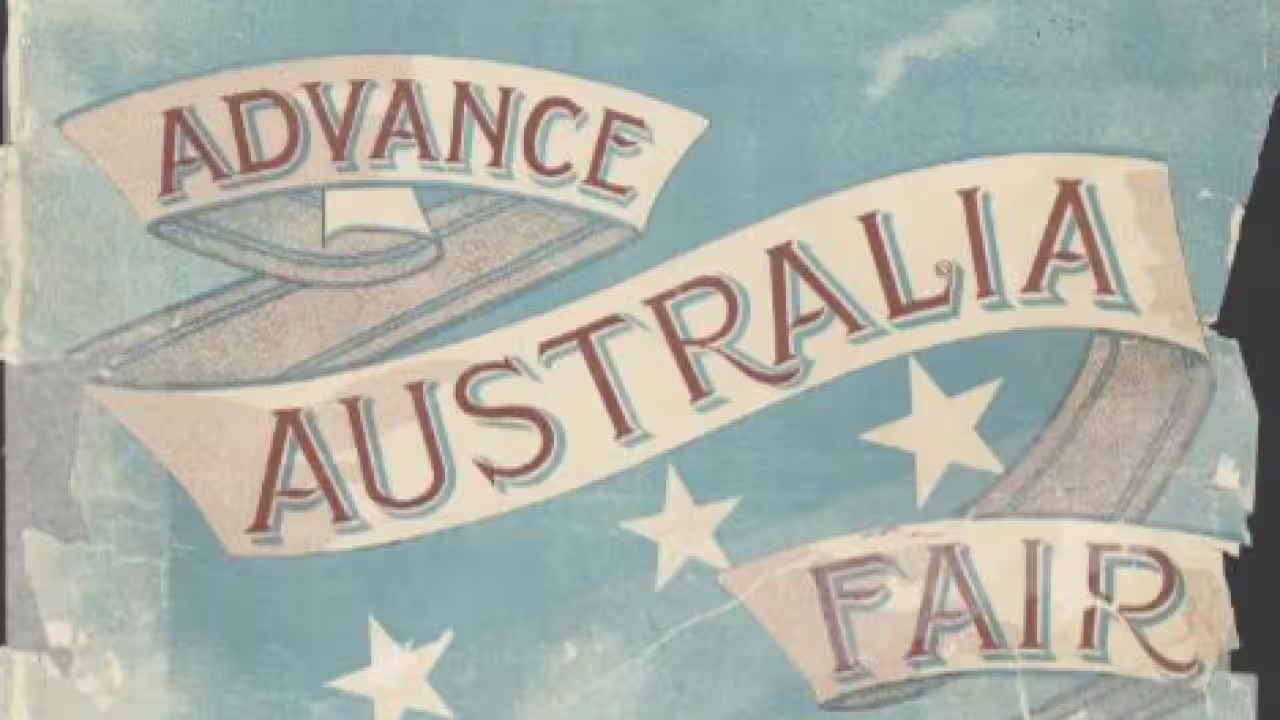
Advance Australia Fair is the official national anthem of Australia, a patriotic song that embodies the nation’s spirit of unity, resilience, and pride. Written in 1878 by Scottish-born composer Peter Dodds McCormick, the anthem replaced God Save the Queen in 1984 and has since stood as a central symbol of national identity. Over the years, the anthem’s lyrics have been modified to better reflect Australia’s multicultural heritage and the recognition of its Indigenous peoples. Today, Advance Australia Fair is sung at major national events, international sporting competitions, and official ceremonies, reinforcing a sense of belonging across the country.
History of Advance Australia Fair
The anthem’s origins trace back to November 1878, when McCormick composed the song under the pen name Amicus. It was first performed at a Highland Society event in Sydney and quickly grew in popularity. By Federation in 1901, a version of the song was performed by a 10,000-strong choir at Australia’s inauguration as a Commonwealth.
Initially, God Save the Queen remained the national anthem, but public sentiment for a uniquely Australian anthem grew after World War II. Prime Minister Gough Whitlam’s government adopted Advance Australia Fair in 1974 following a national survey. However, it was temporarily replaced again by God Save the Queen in 1976 before returning in 1984 under the Hawke government, cemented as the official national anthem.
Evolution of the Lyrics
The original version contained four verses, but when proclaimed in 1984, only two were retained. The most notable modern update came in January 2021, when the line “for we are young and free” was changed to “for we are one and free”. This change acknowledged the deep history of Indigenous Australians, who have lived on the continent for tens of thousands of years, long before European colonization.
Key lyric developments highlight themes of unity, natural wealth, courage, and shared responsibility. By evolving over time, the anthem has stayed relevant while maintaining its patriotic spirit.
Cultural Significance
Advance Australia Fair has become a unifying symbol in sports, politics, and national celebrations. From Olympic medal ceremonies to Australia Day events, the anthem reflects pride and a sense of belonging. Its orchestral arrangement by Tommy Tycho, commissioned in 1984, is now the standard version played at major occasions.
The anthem has also sparked debate and criticism. Some argue that its melody lacks inspiration, while others believe the lyrics fail to fully capture modern Australia’s diversity. Indigenous leaders and activists have often criticized the anthem for not acknowledging colonial history. These criticisms led to the 2021 lyric change, an important step toward inclusion.
Advance Australia Fair and National Identity
Beyond music, the anthem embodies Australia’s journey from colony to independent nation. It reflects the values of equality, multiculturalism, and freedom, while acknowledging the unique challenges of history. Its endurance as a national anthem demonstrates its adaptability and its role as a bridge between tradition and progress.
Conclusion
Advance Australia Fair remains more than just a song—it is a national symbol of pride and unity. Through its history of adaptation, it continues to reflect the evolving Australian identity, balancing respect for the past with recognition of diversity and inclusion. Whether sung in schools, played at sporting events, or performed at state occasions, the anthem captures the enduring spirit of Australia.