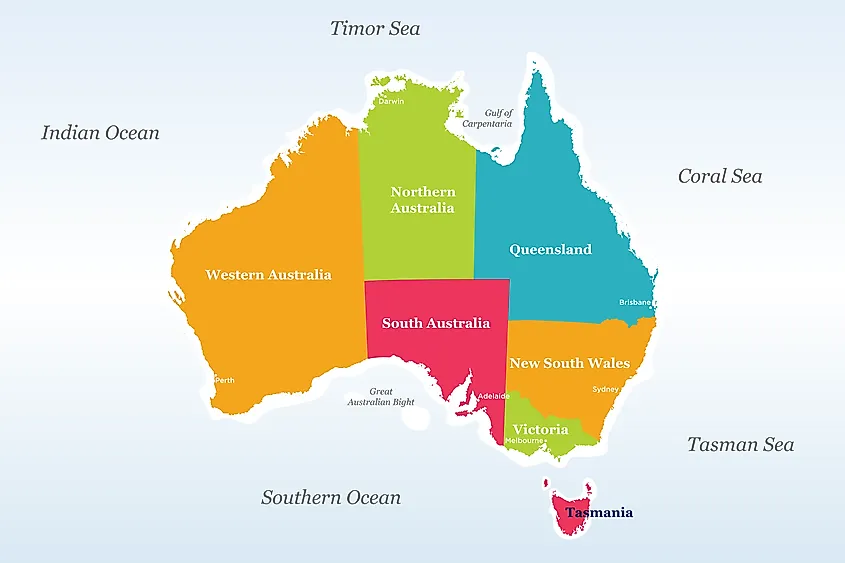
South Australia (SA) is a state located in the southern central part of Australia. Covering an area of 984,321 km² (380,048 sq mi), it is the fourth-largest state by landmass. Despite its size, it is home to just under 1.8 million people, ranking fifth in population. Its population is highly centralised, with over 77% residing in Adelaide, the capital and largest city.
Known as “The Festival State” and “The Wine State”, South Australia is recognised for its world-class wine regions, cultural festivals, and political innovations. It is unique in Australian history as the only colony established as a planned, free settlement, without convict labour. Today, South Australia’s economy is diverse, encompassing agriculture, viticulture, manufacturing, renewable energy, mining, and education.
History
Indigenous heritage
Archaeological evidence suggests human presence in South Australia for over 45,000 years, with Aboriginal communities leaving traces in sites such as Koonalda Cave and the Eyre Peninsula. Distinct groups developed across the state, with deep connections to the land and unique languages, customs, and art.
European exploration and colonisation
The first European sighting of South Australia was in 1627, when Dutch navigator François Thijssen charted the southern coast. Later, explorers Matthew Flinders and Nicolas Baudin mapped the coastline in 1802.
The South Australia Act 1834 authorised the establishment of a convict-free British province, guided by Edward Gibbon Wakefield’s theory of systematic colonisation. The South Australian Company founded an early settlement at Kingscote, Kangaroo Island, in July 1836, before surveyor-general William Light selected Adelaide as the capital. Proclamation Day (28 December 1836) marks the beginning of colonial governance.
Unlike other colonies, South Australia’s foundation charter acknowledged Aboriginal land rights, though in practice these were widely disregarded.
Development and innovation
South Australia became notable for political reform. It was the first colony in Australia to grant women the right to vote and stand for election (1895). The colony joined the Commonwealth of Australia at federation in 1901.
Geography
South Australia is defined by arid and semi-arid rangelands, punctuated by low mountain ranges such as the Mount Lofty Ranges and Flinders Ranges. The state’s highest point is Mount Woodroffe (1,435 m) in the Musgrave Ranges.
Notable geographic features include:
- Coastal regions: Great Australian Bight, Spencer Gulf, Eyre and Yorke Peninsulas
- Plains: Nullarbor Plain, one of the world’s largest limestone landscapes
- Rivers and lakes: River Murray, Lake Torrens, Kati Thanda–Lake Eyre (Australia’s lowest point at –16 m)
Climate
The southern regions enjoy a Mediterranean climate, supporting agriculture and viticulture, while central and northern areas are semi-arid or desert. Oodnadatta recorded Australia’s highest official temperature at 50.7 °C (123.3 °F) in 1960.
Economy
South Australia’s economy is diversified but strongly tied to exports and regional industries.
- Agriculture: Wheat, barley, pulses, almonds, citrus, potatoes, and wine grapes dominate.
- Wine industry: Produces over 50% of Australia’s wine, with regions such as Barossa Valley, McLaren Vale, Clare Valley, and Coonawarra internationally renowned.
- Mining: Home to the Olympic Dam, the world’s largest known uranium deposit, as well as copper, gold, and opal mining in Coober Pedy.
- Renewable energy: South Australia leads the nation in wind and solar power generation, and is home to the Hornsdale Power Reserve, one of the world’s largest lithium-ion batteries.
- Education and research: Adelaide serves as a national education hub, hosting the University of Adelaide, Flinders University, University of South Australia, and multiple research institutes.
Government and Politics
South Australia operates under a constitutional monarchy, with King Charles III represented by the Governor of South Australia. The Parliament of South Australia is bicameral, comprising the House of Assembly and the Legislative Council.
Key political milestones:
- 1857: Introduction of responsible government
- 1895: Women granted voting and candidacy rights (a world first for both combined)
- 1973: Property-based franchise abolished in the Legislative Council, expanding democratic representation
Local governance is managed by 68 councils and Aboriginal community authorities, responsible for local infrastructure and services.
Demographics
- Population (2022): ~1.82 million
- Major city: Adelaide (over 1.3 million)
- Other centres: Mount Gambier, Whyalla, Port Lincoln, Port Pirie, Murray Bridge, Victor Harbor–Goolwa
Cultural composition
At the 2016 census:
- 40.5% English ancestry
- 35.5% Australian ancestry
- 8.9% Scottish, 8.5% Irish, 8.2% German, 6.1% Italian
- 2% Indigenous Australians
Languages other than English spoken include Mandarin, Italian, Greek, and Vietnamese.
Religion
- 35.4% No religion
- 18% Catholic
- 10% Anglican
- 7.1% Uniting Church
South Australia is historically known as the “City of Churches” due to Adelaide’s many religious institutions.
Culture and Festivals
South Australia is branded as the Festival State. Major events include:
- Adelaide Fringe – second-largest annual arts festival in the world
- WOMADelaide – world music festival
- Adelaide Festival of Arts – premier cultural showcase
- Tour Down Under – international cycling race
The state has a strong reputation for gastronomy, with food and wine tourism central to its global image.
Sport
Sport is integral to South Australian identity:
- Australian Rules Football: Adelaide Crows and Port Adelaide Power in the AFL
- Cricket: Matches hosted at Adelaide Oval, including international fixtures and Big Bash League (Adelaide Strikers)
- Soccer: Adelaide United competes in the A-League
- Basketball: Adelaide 36ers in the NBL
- Motorsport: Adelaide 500 Supercars race and The Bend Motorsport Park events
Key Facts
- Capital: Adelaide
- Area: 984,321 km²
- Population: 1.8 million (2022)
- Nickname: The Festival State, The Wine State
- Highest point: Mount Woodroffe (1,435 m)
- Major exports: Wine, wheat, copper, uranium, opal
- Symbols:
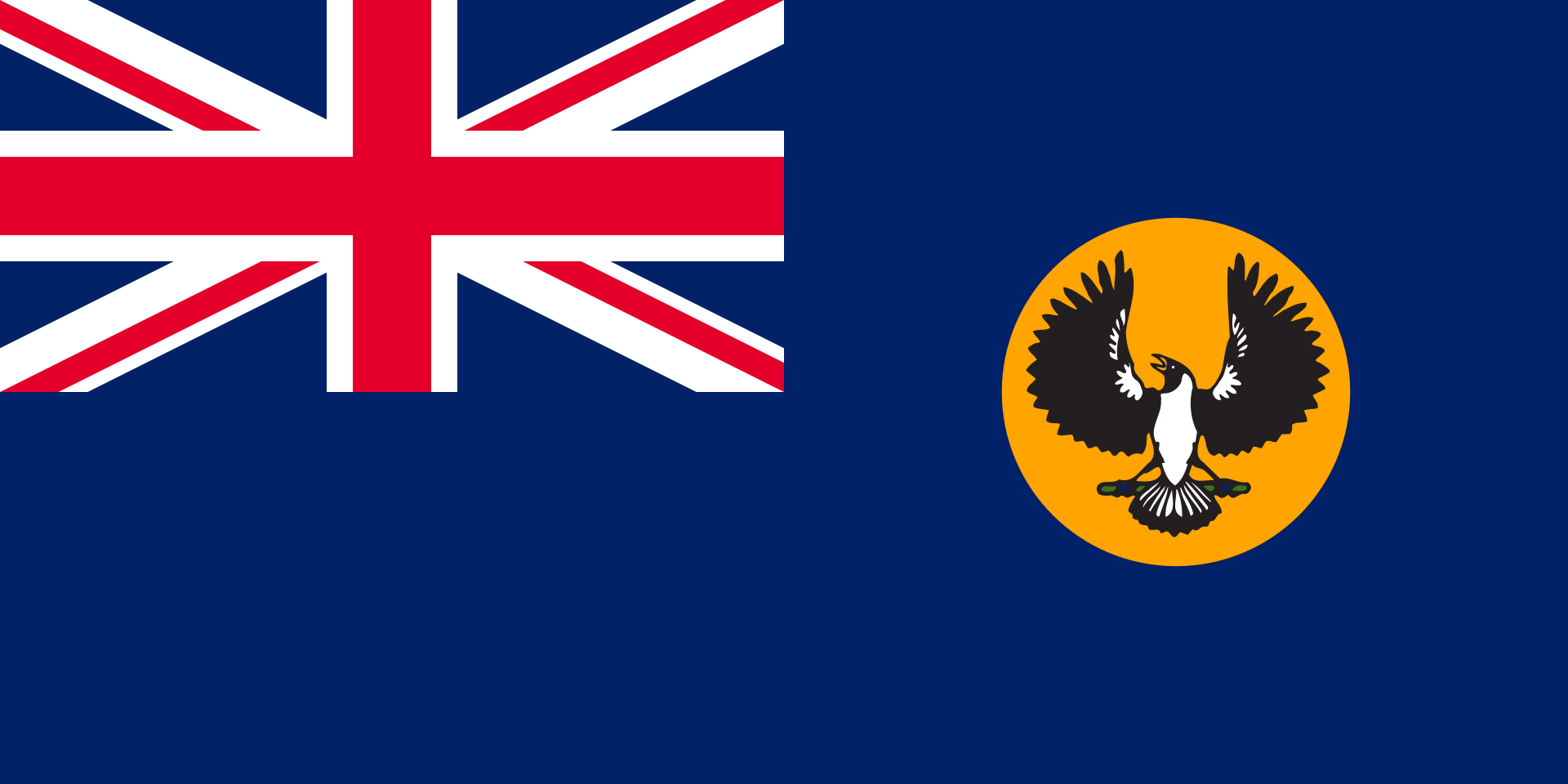
- Bird: Piping shrike (Australian magpie)
- Flower: Sturt’s Desert Pea
- Mammal: Southern hairy-nosed wombat
- Colour: Red, blue, and gold