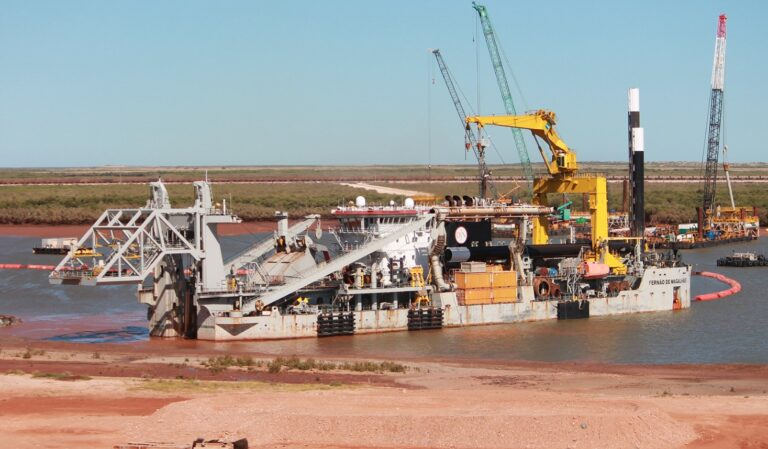
Port Hedland contract activity has taken another step forward after Belgian maritime engineering group Jan De Nul was awarded a $50 million dredging package to help improve safety and resilience at one of Western Australia’s most important export gateways.
The contract, awarded through Pilbara Ports, will see Jan De Nul Australia deliver works for the new Zone 5 Bypass Channel at the Port of Port Hedland. The project is designed to allow vessels to navigate safely around a steeper-edged section of the port’s 42-kilometre shipping channel, known as Zone 5.
The project matters because Port Hedland is not just another regional port. It is one of the world’s largest bulk export hubs and a critical export point for Western Australia’s iron ore industry. Any serious disruption at the port can have consequences for miners, shipping operators, state revenue, national trade and global steel supply chains.
The state government says the bypass channel will improve safety, efficiency and resilience by adding another navigation option for large vessels operating within tight tidal windows. It will complement existing passing lanes and refuge areas, giving the port more flexibility if an incident or operational constraint affects part of the channel.
For Jan De Nul, the award strengthens its long-running role in Port Hedland’s maritime infrastructure program and reinforces its position as a major dredging contractor in Australia.
What the Zone 5 Bypass Channel Will Do
The Zone 5 Bypass Channel is intended to reduce navigational risk in a complex and highly active shipping environment.
Port Hedland’s shipping channel is used by some of the largest bulk carriers in the world. These vessels often move in convoy and must operate within carefully managed tidal windows. That creates pressure on port scheduling, navigation planning and risk management.
The new bypass channel will create an alternative route around Zone 5, a steeper-edged part of the channel. This means vessels may have more room to navigate safely if conditions become difficult or if part of the channel is affected by an incident.
In practical terms, the project is about keeping trade moving. The port cannot afford avoidable delays, especially given the scale of iron ore exports that pass through it. A bypass channel improves operational resilience by reducing the chance that one problem in one section creates wider disruption.
Why Port Hedland Is So Important
Port Hedland is central to Western Australia’s economy because it handles massive volumes of bulk exports, especially iron ore from the Pilbara.
The port supports some of the world’s largest mining companies and links inland mining operations with global customers. Much of the iron ore shipped through Port Hedland goes to Asian steel markets, making the port a key part of international industrial supply chains.
Because of that, port reliability matters. A disruption at Port Hedland can affect shipping schedules, commodity flows, export revenue and investor confidence. Even short delays can create operational and financial pressure because of the size and value of the cargo moving through the port.
That is why infrastructure upgrades at Port Hedland often have significance beyond the port itself. They support the broader mining economy and help maintain Western Australia’s reputation as a reliable trading partner.
Why the Contract Was Awarded to Jan De Nul
Jan De Nul is one of the world’s major maritime engineering and dredging groups. The company has worked on large-scale marine infrastructure projects across many countries, including previous works at Port Hedland.
Its experience in dredging, channel development and port engineering makes it a logical contractor for a project that requires precision, safety and careful environmental management.
Dredging in a major export port is not simple. Work must be planned around vessel movements, tides, environmental conditions and port operations. Contractors must deliver without causing unnecessary disruption to trade.
For Pilbara Ports, selecting an experienced dredging group helps reduce delivery risk. For Jan De Nul, the contract further strengthens its Australian project portfolio and its relationship with Western Australia’s port sector.
Preventing Operational Pain at the Port
The purpose of the $50 million investment is to prevent future operational pain before it happens.
In a port like Port Hedland, risk management is critical. Large vessels, narrow channels, tidal timing and high export volumes create a system where small disruptions can quickly become expensive. A bypass channel gives port managers another tool to keep traffic moving safely.
The project is not about increasing exports overnight. It is about protecting the reliability of existing and future operations. If ships can move more safely and with more flexibility, the port becomes more resilient.
That resilience matters to miners, shipping companies, tug operators, pilots, exporters and customers overseas. It also matters to the Western Australian government because the port underpins a large part of the state’s economic engine.
Industry Support and Technical Planning
The state government says the project was developed in consultation with major port users and informed by detailed technical studies.
That consultation is important because port users understand the daily operating challenges of the channel. Shipping companies, mining exporters and maritime operators all have a direct interest in safe and efficient vessel movement.
Technical planning also matters. A bypass channel must be designed around navigation safety, vessel size, tidal movement, seabed conditions and environmental requirements. Navigational simulations, geotechnical assessments and environmental investigations help determine whether the design is practical and safe.
This type of planning reduces the risk that infrastructure is built in the wrong place or fails to solve the operational problem it was designed to address.
How the Project Fits WA’s Economic Strategy
The Port Hedland contract also fits into Western Australia’s wider economic development strategy.
The state government has described Port Hedland as part of its long-term regional development vision. That vision aims to support growth in major regional centres, strengthen export infrastructure and unlock future economic opportunities.
For the Pilbara, port infrastructure is especially important. The region’s economy depends heavily on mining, logistics, energy and export activity. A safer and more resilient port helps support that industrial base.
Investments like the Zone 5 Bypass Channel may not always attract the same attention as new mines or large processing plants, but they are essential. Without reliable port infrastructure, resource projects cannot reach global markets efficiently.
Dredging Works Expected to Begin
Dredging works are expected to begin in September, according to industry reporting.
The timing will be important because works must be coordinated with ongoing port operations. Port Hedland is a busy export hub, so project delivery will need to avoid unnecessary disruption to vessel movements.
Dredging also requires environmental controls. Marine works can affect seabed conditions, turbidity and nearby habitats if not managed carefully. Contractors and port authorities typically apply monitoring and management plans to reduce environmental risk.
Once completed, the bypass channel should add another layer of operational flexibility to the port’s navigation system.
What It Means for Miners and Exporters
For miners and exporters, the project is about certainty.
Iron ore supply chains depend on reliable movement from mine to rail to port to ship. If the port becomes a bottleneck, the entire supply chain can feel the impact.
A bypass channel can help reduce the risk of delays linked to channel constraints or maritime incidents. That gives exporters more confidence that cargo can move through the port safely and efficiently.
It may also support future growth planning. As export volumes and vessel movements evolve, ports need infrastructure that can handle operational complexity. The Zone 5 Bypass Channel is part of that longer-term resilience planning.
What It Means for the Pilbara
For the Pilbara region, continued investment in Port Hedland reinforces the area’s role as one of Australia’s most important economic corridors.
The Pilbara is central to the state’s mining economy, but its growth depends on infrastructure. Roads, rail, ports, power, water and housing all shape the region’s ability to support major industry.
A safer and more resilient port can support jobs, contractor activity and long-term confidence in the region’s export capacity. It also helps maintain Port Hedland’s position as a critical maritime hub.
The project may be relatively modest compared with multi-billion-dollar mining developments, but its strategic value is high because of what it protects.
Why Port Resilience Is Becoming More Important
Port resilience is becoming more important as global supply chains face more pressure from weather events, geopolitical risk, vessel congestion and rising trade volumes.
Major export ports must be able to withstand disruptions and recover quickly. This requires more than routine maintenance. It requires planned investments that reduce single points of failure.
The Zone 5 Bypass Channel is an example of resilience infrastructure. It is designed to give the port more flexibility if a problem occurs in a sensitive part of the shipping channel.
For a port that handles some of the world’s largest vessels, that flexibility can be extremely valuable.
Investor and Industry Takeaway
The Jan De Nul Port Hedland contract shows continued investment in Western Australia’s export infrastructure.
For the maritime sector, it confirms ongoing demand for specialist dredging and marine engineering services. For the resources sector, it points to continued focus on protecting key iron ore export routes. For the state government, it supports the message that infrastructure resilience remains a priority.
The key point is that the contract is preventive. It aims to reduce the risk of future disruption rather than respond after a major problem occurs.
That approach can be more cost-effective in critical infrastructure. Spending $50 million now may help avoid far larger costs if a channel incident were to disrupt port operations later.
Conclusion
Jan De Nul’s $50 million Port Hedland contract is a strategic investment in safety, efficiency and resilience at one of the world’s most important bulk export ports.
The project will deliver dredging works for the new Zone 5 Bypass Channel, allowing vessels to navigate around a steeper-edged section of the port’s 42-kilometre shipping channel. The bypass will complement existing passing lanes and refuge areas, giving port operators more flexibility in a high-volume maritime environment.
For Western Australia, the project protects a critical part of the state’s export economy. For Pilbara Ports, it strengthens risk management. For miners and shipping companies, it supports more reliable vessel movement. For Jan De Nul, it reinforces the company’s role as a trusted marine infrastructure contractor in Australia.
Port Hedland’s importance to iron ore exports means even small improvements in safety and reliability can carry major economic value. The Zone 5 Bypass Channel is therefore not only a dredging project. It is a safeguard for one of Australia’s most important trade corridors.
Read Also: WA Net Zero Cost Put at $8.6b a Year