The phrase “Victoria may soon become ungovernable” carries real weight. It signals a sense that multiple pressures — administrative, fiscal, social, and political — are converging in a way that could overwhelm the machinery of government.
This warning has arisen especially around the proposed treaty legislation that would grant sweeping powers to a new First Peoples’ Assembly. Critics argue that the costs, scope, and institutional complexities of the bill could strain Victoria’s public service, budget, and governance processes to breaking point.
But that is only one node in a larger web of crises. Victoria is wrestling with rising crime, eroding public trust in institutions, declining investment, fiscal stress, and fierce ideological confrontations. The notion of “ungovernability” is not inevitable — but it is gaining plausibility unless decisive reforms are made.
Let’s unpack the main pressures building on Victoria’s government, and what choices lie ahead.
The treaty legislation: a lightning rod for governance risk
At the heart of the “ungovernable” argument is Victoria’s proposed treaty legislation, which would establish a First Peoples’ Assembly possessing considerable powers: to review and advise on all legislation, question ministers and government departments, launch initiatives in education and justice, and address institutional racism.
Supporters see it as a historic step in reconciliation and Indigenous self-determination. But opponents warn it risks creating a parallel administrative structure — a quasi-second legislature with overlapping accountability and bureaucratic burden.
Among the concerns:
- The bill is said to run to more than 200 pages of intricate provisions.
- Initial funding is modest (around $24 million), but projections see it rising to $72 million by 2028–29, with further upward pressures as responsibilities expand.
- Critics argue the Assembly’s scope could entail constant review of departmental decisions, adding layers of oversight and bottlenecks.
- Some fear the bill may overload an already stretched public service, slow decision-making, and lead to jurisdictional clashes.
One commentary puts it starkly: “Victoria’s public service could face an unprecedented administrative burden under proposed treaty legislation … it is even possible that our second-largest state will become ungovernable.”
There is also financial risk: with public debt already mounting and service delivery demands escalating, any overruns or structural inefficiencies tied to the Assembly might stress Victoria’s credit standing.
In sum, treaty legislation is not just a cultural or symbolic shift; it poses tangible bureaucratic and fiscal tests for the state government. How Victoria integrates it — or fails to — will be a critical barometer of whether it becomes ungovernable.
Crime and public safety: the tipping-point stress
Even without the treaty debate, Victoria is under intense strain from surging crime. The public senses it. The data backs it.
In the 12 months to July 2025, offences rose by 15.7%, equating to 86,587 more crimes than the previous year. Adjusted for population, crime increased ~14%.
The rise has included violent incidents, stabbing deaths of young people, and attacks on police — creating scenes of alarm across Melbourne and regional Victoria.
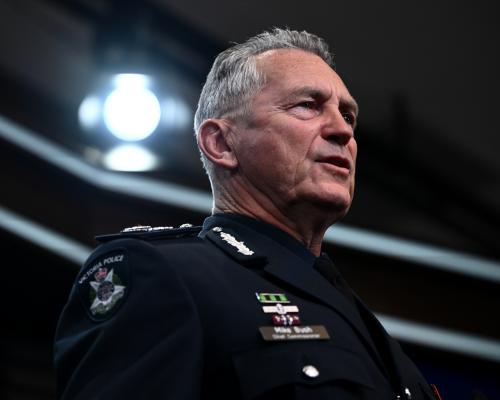
Victoria Police’s new Chief Commissioner, Mike Bush, has responded with plans to overhaul the force: removing bureaucratic burdens from frontline officers, cutting the number of deputy commissioners, and forming a state crime coordination centre. He believes reallocating just some of the officers now tied to administrative duties could significantly reduce crime.
His sweeping reforms are billed as the most significant restructuring in over a decade. The aim: leaner, more responsive policing. But the reforms must succeed quickly or risk being overtaken by events.
The crime situation has also eroded public confidence. Surveys show satisfaction in policing has plunged from ~75% to ~52%, and confidence fell from about 62% to 55%. The gap between community expectations and perceived capacity is widening.
All of this injects a political urgency into law and order. The state government has already passed bail reform and a machete ban, aiming to clamp down on youth offending and weapon violence. But critics say reactive crime bills alone won’t fix deeper social, economic, and systemic issues.
If crime continues to spiral, the government’s capacity to govern coherently could deteriorate — as policing, social order, and community trust all come under strain.
Economic collapse, investment flight, and fiscal pressures
A third pillar pushing Victoria toward ungovernability is its economic and fiscal predicament.
Business sentiment is souring. To many analysts, Victoria has become the hardest state in Australia to do business in. Complex red tape, sluggish permits, high energy and gas costs, regulatory burden, and rising taxes are blamed for undermining investment.
Gas shortages and looming blackouts add to uncertainty.
Tax pressures are significant: land taxes have soared, payroll taxes have nearly doubled since the pandemic, and new emergency and mental health levies are burdening business.
Victoria’s public debt is on track to near $200 billion, with no clear plan to rein in spending or avoid a credit downgrade.
These pressures also affect service delivery: infrastructure projects are delayed or over budget, unions are strong, and functional inefficiencies mount.
In this context, funding a new powerful First Peoples’ Assembly, with its oversight and operational load, injects further risk. If the Assembly’s costs balloon or interfere with existing service responsibilities, government finances may buckle.
A compounding effect arises: as services lag and crime rises, the public’s tolerance for government failure erodes — making it harder for any administration to maintain legitimacy.
Political instability, polarization, and governance paralysis
Beyond structural problems, there are deep political tensions and governance risks.
The treaty legislation has become a sharp political fault line. The opposition has vowed to repeal the bill within 100 days if elected, describing it as divisive and financially untenable.
Some commentators warn that granting broad review and veto powers to a parallel body may lead to bureaucratic gridlock and contestation between the Assembly and traditional departments.
The notion of overlapping authority raises legal and constitutional disputes. Who has the final say? What happens when a departmental action is challenged by the Assembly? These questions could stall governance on core functions.
The pressure intensifies in a state already fractured by social issues. For example, neo-Nazi activists occupied the steps of Victoria’s Parliament for the second time in two years, reigniting debate over protest laws and extremism.
Meanwhile, public trust in institutions — especially police and government itself — is slipping. The gap between citizen expectations and delivery is wide.
If the government becomes mired in internal fights, legal challenges, and bureaucracy, its ability to respond to core issues — crime, health, education, infrastructure — will be hampered. That is the territory of “ungovernability.”
Possible tipping points and paths forward
Victoria is not yet lost. But avoidable decisions now could determine whether it remains governable or slides toward dysfunction. Some key factors to watch:
1. Implementation discipline on treaty powers
If the First Peoples’ Assembly is descaled, phased in carefully, with clear boundaries and accountability, the risk of collapse can be managed. But if it’s rushed, ambiguous, or expands unchecked, it may overwhelm governance flows.
2. Crime reform success
Chief Commissioner Bush’s restructuring must show quick wins — rebalancing resources to frontline policing, data coordination, and crime prevention. If crime continues rising despite reforms, governmental legitimacy erodes rapidly.
3. Fiscal restraint and prioritization
The government must show that new spending — including for the Assembly — does not cannibalize core services or drive the state into crisis. Transparent budgeting and credible debt control matter.
4. Political consensus or crossbench cooperation
Given a fractious legislature, the government will need crossbench support or negotiated compromises. Polarized debate will stall progress. Managing opposition to treaty and crime laws is essential.
5. Restoring public trust
Rebuilding confidence in police, institutions, and public service is essential. Without legitimacy, citizens will view even well-intentioned measures as failures.
If the government mishandles any of these, the “ungovernable” diagnosis may become reality.
Conclusion: A state at risk of fracturing
Victoria stands at a precarious intersection of institutional ambition and practical strain. The treaty legislation — though emotionally and symbolically powerful — risks being the fulcrum that tips the balance. Combine that with a sharp increase in crime, declining public trust, fiscal stress, and political polarization, and the ingredients for dysfunction are painfully present.
“Ungovernable” is not destiny. But the path to effective governance ahead is narrow and perilous. If the state government does not act with discipline, clarity, and courage, the machinery of Victoria may start to grind — and in the worst case, fail.