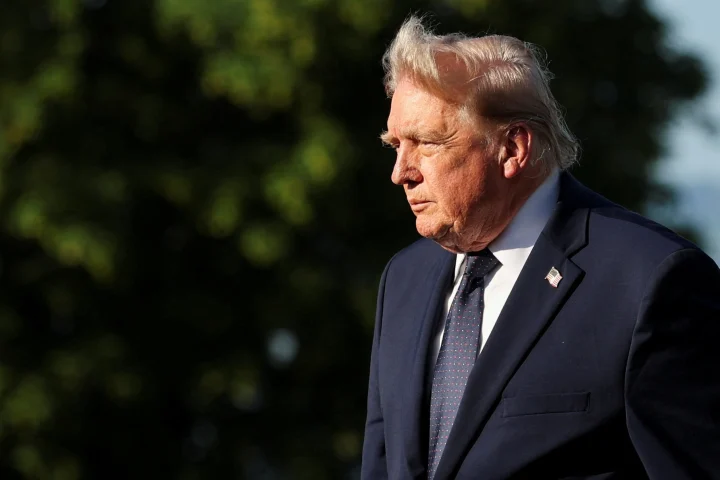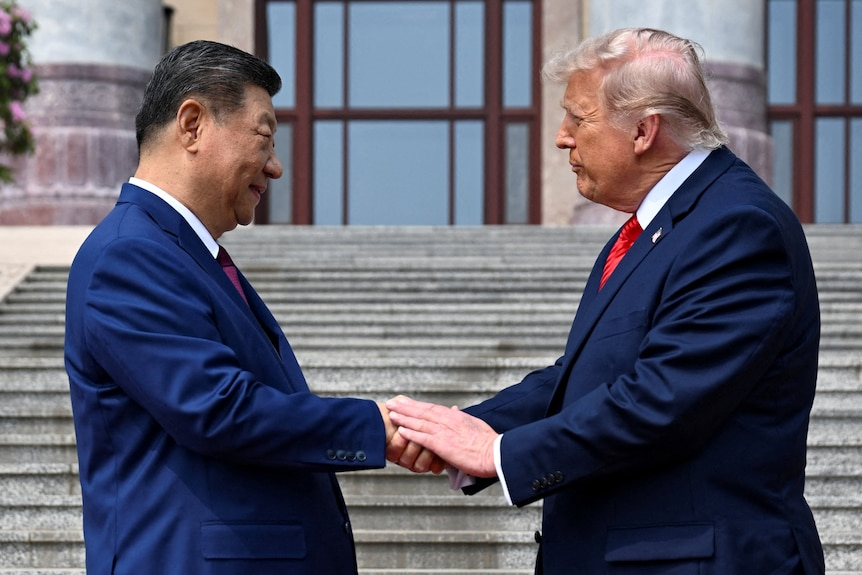
US President Donald Trump has arrived in Beijing for a major two-day summit with Chinese President Xi Jinping, accompanied by an influential delegation of billionaires, corporate executives and senior US officials as the world’s two largest economies attempt to stabilize increasingly tense trade and technology relations.
The high-level visit comes amid ongoing geopolitical rivalry between Washington and Beijing over trade, artificial intelligence, semiconductor restrictions, Taiwan and strategic global influence.
Trump’s entourage includes some of America’s most powerful business leaders, highlighting how economic interests remain central to the relationship between the United States and China despite years of escalating tensions.
Among the executives accompanying Trump are Elon Musk, Jensen Huang, Tim Cook, BlackRock CEO Larry Fink, Blackstone co-founder Stephen Schwarzman, Boeing CEO Kelly Ortberg, Goldman Sachs CEO David Solomon and Qualcomm CEO Cristiano Amon.
Senior US government officials on the trip include Secretary of State Marco Rubio, Defense Secretary Pete Hegseth and Trade Representative Jamieson Greer.
Trade and Technology at the Center of Talks
Trade remains the dominant issue in the Trump-Xi summit after relations deteriorated sharply during last year’s tariff disputes.
Trump’s “Freedom Day” tariffs triggered retaliatory measures from Beijing, including restrictions on critical rare earth mineral exports and reduced purchases of American agricultural products such as soybeans.
The technology sector has become another major battleground between the two powers.
Washington previously imposed restrictions on advanced semiconductor exports to China, targeting AI and high-performance computing capabilities. Beijing responded by tightening controls over strategic mineral exports vital to battery manufacturing, defense industries and electronics production.
The presence of Nvidia CEO Jensen Huang and Tesla CEO Elon Musk underscores the growing importance of artificial intelligence and electric vehicle industries in US-China negotiations.
AI competition has rapidly become one of the defining issues in global geopolitics, with both countries racing to dominate semiconductor development, cloud computing and next-generation digital infrastructure.
Business Executives Seeking Market Access
Trump indicated before arriving in Beijing that one of his key objectives is securing greater access for American firms operating in China.
The business delegation is expected to pursue investment agreements, technology partnerships and commercial deals during the summit.
Such corporate participation is not unusual during presidential visits to China. During Trump’s 2017 trip to Beijing, companies from both countries signed trade and investment agreements reportedly worth more than $250 billion.
This year’s summit could similarly produce announcements involving technology, manufacturing, finance and infrastructure cooperation, although analysts caution that geopolitical tensions remain far deeper now than during Trump’s first term.
AI and Strategic Competition Dominate Agenda
Artificial intelligence is expected to play a central role in discussions between Trump and Xi.
Since Trump’s previous Beijing visit in 2017, AI has evolved into a critical area of economic and military competition between global powers. Semiconductor access, AI model development and cloud infrastructure are increasingly tied to national security concerns.
China and the United States are also expected to discuss broader strategic stability mechanisms aimed at reducing tensions and preventing further deterioration in bilateral relations.
According to statements released during the summit, the two countries are establishing a formal “China-US Constructive Strategic Stability” framework intended to guide future engagement between the two powers.
Why the Summit Matters
The Beijing meeting comes at a critical moment for the global economy.
US-China relations influence international trade flows, technology supply chains, semiconductor markets, energy security and financial systems worldwide. Any improvement or deterioration in relations between the two countries has direct consequences for global markets and multinational businesses.
For companies represented in Trump’s delegation, China remains one of the world’s largest and most strategically important markets despite rising political risks and regulatory uncertainty.
The summit is also being closely watched for signals on Taiwan, AI regulation, global manufacturing and future tariff policy, all of which could reshape international business and geopolitical dynamics over the coming years.