The challenge: shark bites in Australian waters
Australia has among the world’s busiest coastlines — millions of people access the ocean for swimming, surfing, diving and recreation. At the same time, large predator sharks (such as the great white shark, tiger shark and bull shark) are present in many near-shore waters. Recently, authorities say shark-human interactions are rising, prompting greater focus on prevention.
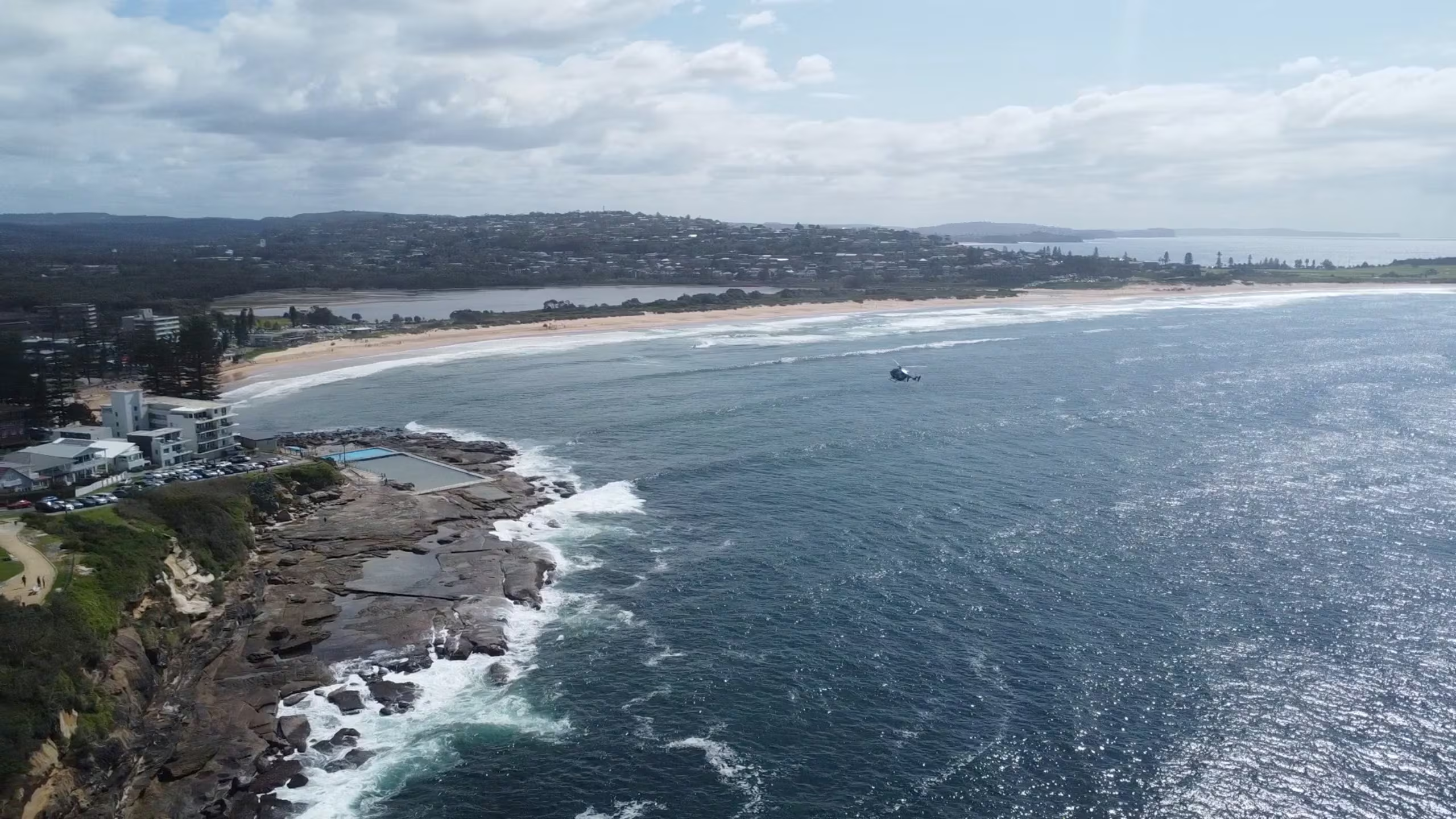
For example, a recent fatal attack off a Sydney beach spurred increased drone and other surveillance deployment.
Given the public safety risk — even though fatal attacks remain rare — beach-management agencies are ramping up efforts. The key is: how to reduce risk rather than eliminate it (because eliminating it entirely is practically impossible).
New‐Tech Approaches
Drone + AI surveillance
One of the most visible recent innovations: drones flying above beaches, using high‐resolution cameras plus artificial intelligence (AI) to detect sharks in the water.
The University of Technology Sydney (UTS) developed a system called “SharkSpotter” which uses aerial drones + deep learning image processing to identify sharks (and other water users) from live video streams.
According to UTS, the system has about 90 % accuracy in distinguishing sharks from other objects in the water (versus only ~16 % accuracy by the naked eye).
In practice, in the state of New South Wales (NSW), drones have flown thousands of hours: for example, over 2,000 hours, covering ~25 ,000 km, observing ~350 sharks, evacuating beaches about 48 times so far.
Why this matters:
- Drones can cover large coastline stretches more quickly than lifeguards on foot or from towers.
- Real-time footage means quicker alerts: if a shark is spotted heading toward swimmers/surfers, warnings or evacuations can happen sooner.
- The AI component reduces reliance solely on human spotting (which can miss things).
- The footage and data collected also feed into research on shark behaviour, patterns and risk zones.
Limitations & caveats:
- Drones work best when visibility is good (clear water, daylight, calm surf). In murky, rough, or low-light conditions their effectiveness drops.
- They are a monitoring tool, not a guarantee of safety. If a shark appears suddenly, or in a zone not covered, risk remains.
- The system is resource-intensive: drone operators, maintenance, batteries, AI training – all cost money. The NSW program reportedly costs ~A$14 million/year.
- Some communities emphasize that while drones provide detection, behavioural safety (swimming at designated times, avoiding lone swimming at dawn/dusk, etc.) remains crucial.
SMART Drumlines & tagging
Another technology layer: Instead of only relying on nets or static barriers, authorities are deploying “SMART” drumlines — baited hooks/lines equipped with sensors that alert operators when a shark is caught, tagged and usually released. In NSW, these are part of the coastal safety mix.
What this adds:
- It allows for targeted monitoring of large shark presence near swimming zones.
- Tagged sharks can alert via acoustic receivers when they come into proximity of beaches.
- It is less lethal (or non-lethal) compared with older methods that killed many sharks and by-catch species.
For example: one article notes that in NSW, after deploying the combination of drones + SMART drumlines, in a five-year span no shark-human interaction occurred at a beach protected by those technologies, compared with 19 in a similar previous period.
Integrated tech & data systems
Beyond drones and drumlines, beach safety agencies maintain programs for shark deterrents such as electronic fields (e.g., personal devices that create an electromagnetic field to confuse a shark’s sensing) – like the device by Shark Shield/Ocean Guardian.
Also, research into newer wetsuit materials (as per other studies) show bite‐resistant suits can reduce injury severity.
Thus, the “new tech” side involves surveillance, detection, tagging/tracking, protective gear — all complementing the older systems.
The “Old” / Traditional Methods & Why They Still Matter
While the headlines focus on high-tech, many of the older methods remain in play and are still relevant.
Shark nets & barriers
In NSW and other coastal regions, shark nets have been used for decades: large submerged nets on popular beaches meant to intercept sharks. But they have downsides: they can entangle non-target marine life (dolphins, turtles), they don’t provide a clear physical exclusion zone (sharks can swim around/over them), and evidence on their effectiveness is mixed.
Because of the environmental cost and questionable effectiveness, many states are gradually moving away from nets or reducing reliance on them, alongside newer technologies. For example, the NSW government has begun considering net removal pending reliable replacement technologies.
Drumlines (traditional) & beach safety practices
Before SMART drumlines, many beaches used simple baited drumlines that caught and killed sharks. These raised environmental and ethical issues. The new SMART lines are more refined.
Additionally, traditional lifeguard methods — beach closures when sharks are spotted, public education on safe swimming times and behaviour, flag systems — still play a foundational role.
Public education & behaviour
Ultimately, technology cannot eliminate risk: human behaviour is still key. Swimmers and surfers are still advised to avoid entering the water at dawn/dusk, stay in groups, avoid murky water, avoid being near outflows or bait-fish concentrations, etc. Also, being aware of local signage and lifeguard instructions remains vital.
Australia’s Strategy: Combining Old + New
What’s interesting in the Australian approach is the hybrid model: not just deploying each method in isolation, but layering them such that they complement each other. For example:
- Drones monitor for sharks and send alerts to lifeguards, who can then respond with closures or warnings.
- SMART drumlines tag sharks, feed data to listening stations, which then integrate with beach safety alerts.
- Protective gear (wetsuits, devices) offer additional personal safety.
- Traditional nets/barriers are still deployed in some areas while newer methods scale up.
According to the NSW agency SharkSmart (which leads trials and research in NSW), in the past five years they have been “leading the world” in shark-research and trialling new/emerging technologies for shark-bite mitigation.
A specific case: In NSW, one article states that from the start of the drone + SMART drumline deployment, “there hasn’t been a shark-human interaction at a beach protected by those methods” over five years, compared with 19 in a similar previous period.
That suggests initial success — though it’s early days and meant as part of a broader risk-reduction strategy.
A Case Study: Drones in Action
A concrete story: a drone pilot flying at a NSW beach spotted the silhouette of what turned out to be a great white shark (around 7 ft / ~2.1 m). He radioed lifeguards, warnings were issued, swimmers cleared the water. The shark then moved away.
In another beach zone, the drones had logged ~2,000 hours of flight and evacuated beaches 48 times over a monitoring period.
These operations underscore the time-sensitive nature of shark encounters: being able to spot a predator approaching and issuing a warning can literally mean the difference between a safe outing and a tragedy.
Remaining Challenges & Criticisms
Despite these advances, there are several challenges and caveats:
- Coverage & cost: Drones and monitoring systems cost money; they need trained pilots, equipment, and maintenance. Some regions with less funding may struggle to implement full coverage.
- Detection limitations: Several factors reduce effectiveness — poor water visibility, rough surf, glare, shadows, or sharks approaching from below/out of view. Drones are not foolproof.
- Behavioural complacency risk: There’s a danger that people assume technology makes the beach “safe” and take greater risks (swimming offshore alone, late at night, etc.). The human factor remains critical. One scientist warned: “When you enter wildlife’s domain, you do it at your own risk.”
- Environmental concerns: Some of the traditional methods (nets, lethal drumlines) have major impacts on marine ecosystems. Sharks and other animals are part of marine biodiversity, and lethal reduction strategies are controversial.
- Statistical certainty: While initial data are promising, it is difficult to definitively attribute reductions of interactions purely to one technology or another, because many factors (human behaviour, shark ecology, beach usage patterns) also change.
- Scaling to remote/coastal regions: Popular beaches near major cities may get the advanced tech; but more remote beaches may not — leaving gaps.
- Public trust & perception: For example, the older nets made beachgoers feel “safe”, but critics say that sense of safety was misleading. New technologies must build public trust and clear communication is needed.
What this means for beachgoers & communities
For people using the beach:
- Recognise that risk exists, though it is low. The presence of sharks is part of the marine environment, not something one can completely eliminate.
- Use the beaches where monitoring/mitigation is in place (drones, SMART drumlines, lifeguards) where possible.
- Stay alert to warnings: if a drone operator spots a shark and alerts lifeguards, pay attention to instructions.
- Continue good behaviour: swim in designated zones, avoid being alone or too far from others, avoid twilight/dusk when some sharks feed, avoid murky water/outflow zones, obey signage/flags.
- Be aware: technology is there to help reduce risk but not guarantee zero risk.
For local authorities & communities:
- Investing in drone fleets, AI monitoring, tagging/track systems appear to be paying off and may allow the gradual phasing out of more environmentally harmful methods (like nets) while also enhancing public safety.
- Data collection matters: better understanding of shark behaviour around beaches helps design better mitigation.
- Communication is key: explain to the public what systems are in place, their limitations, what to do if a shark is spotted.
- Environmental balance: Mitigation strategies must respect marine ecosystems; reducing shark-human interactions should not come at undue cost to other marine life or biodiversity.
Why Australia is particularly pushing this
Several reasons make Australia a strong focus for these efforts:
- Huge coastline, many surf/beach users: the baseline exposure is high.
- High profile shark‐human interactions (including fatalities) that draw public concern and media attention. For example, the recent attack in NSW spurred drone/helicopter deployment.
- Advances in drone/AI and tagging technology make it feasible to deploy more sophisticated systems now than in past decades.
- Strong research institutions (e.g., UTS) and beach safety agencies willing to trial these technologies.
- Growing expectation from the public for safer beach experiences, especially in tourist‐heavy zones.
Conclusion
Australia’s strategy to fend off shark bites is evolving from simple nets and reactive lifeguards to a more layered, proactive model: drones with AI monitoring, SMART drumlines and tagging, protective gear, combined with traditional lifeguard presence and public education.
The headline “Australia fends off shark bites with new tech and old” captures it well: there is no single magic bullet, but a combination of old and new methods aimed at reducing risk.
The early data are promising — fewer interactions in protected beaches — but the system is still evolving, and the challenge remains significant. For beach-goers, the message is: enjoy the water, stay safe, heed warnings, and know that while technology helps, individual behaviour still matters.