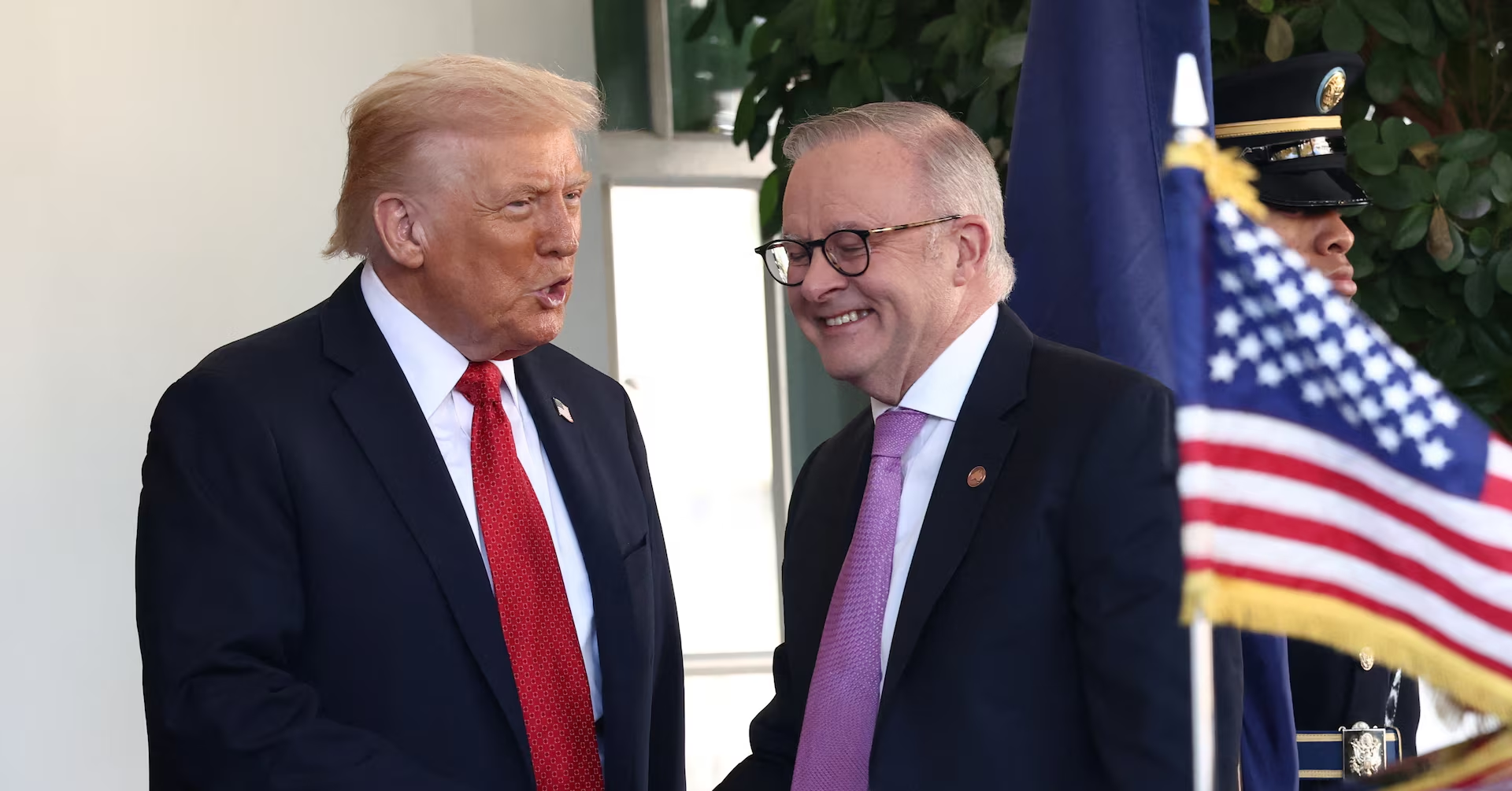
On October 21, 2025, U.S. President Donald Trump and Australian Prime Minister Anthony Albanese signed a landmark agreement on critical minerals and rare earths. The deal aims to reduce global dependence on China, which currently dominates the mining and refining of these essential materials.
This agreement represents more than a trade partnership — it is a strategic move to reshape supply chains, boost national security, and strengthen Western alliances in the Indo-Pacific region.
Key Elements of the Agreement
Size of Commitment
The deal is valued at $8.5 billion in planned investments. Both countries have pledged $1 billion each over the next six months to support new mining and processing projects.
According to White House estimates, the projects unlocked by this framework could generate over $53 billion worth of recoverable resources.
This joint investment will expand Australia’s mining sector and ensure the U.S. gains a reliable supply of minerals vital for advanced technologies like electric vehicles, semiconductors, and defence systems.
Supply-Chain and Processing Commitments
The agreement extends beyond mining raw materials. It focuses on processing, refining, recycling, and supply-chain security for critical minerals and rare earth elements.
Both countries will collaborate on:
- Geological mapping to identify potential mining zones.
- Recycling programs to recover valuable minerals from industrial waste.
- Establishing a U.S.–Australia Critical Minerals Supply Security Response Group led by their energy and resources ministers.
One major project involves a gallium refinery in Western Australia, developed with Alcoa Corporation and Japanese partners. Once operational, it could supply up to 10 % of the world’s gallium, a key metal used in semiconductors and satellites.
Setting a Price Floor
For years, Western mining companies have complained about China’s price manipulation. Low Chinese prices make it difficult for others to compete.
To address this, the U.S. and Australia agreed to set a minimum price floor for key minerals. This will help create market stability, encourage investment, and protect producers from unfair competition.
Strategic Framing Against China
Although presented as an economic deal, the agreement carries a clear strategic message.
It aims to reduce Western dependence on China’s control of mineral supply chains. By building new processing centers in trusted countries, the U.S. and Australia hope to secure the materials required for national defense, clean energy, and advanced manufacturing.
In short, the deal merges economic cooperation with geopolitical strategy.
Why This Matters: The China Dimension
China currently dominates 70 % of rare-earth mining and 90 % of processing capacity worldwide. These minerals are critical for producing electric vehicles, wind turbines, smartphones, and military guidance systems.
In recent months, China tightened export controls on rare-earth materials. It now requires foreign companies to seek Chinese approval even for products containing trace amounts of Chinese-sourced minerals.
The new U.S.–Australia deal marks a strategic shift. Rather than depending on China’s supply, the allies are building alternative supply routes in friendly territories.
This signals that rare earths are no longer only a commercial issue, but also a matter of national security and industrial independence.
Strategic Implications
For the U.S. and Australia
Australia already leads the world in rare-earth exploration, with nearly 90 active projects. The U.S. gains a stable supplier and a trusted ally to counter China’s dominance.
In return, Australia receives new investment, job creation, and advanced technology transfers.
This partnership also supports other alliances like AUKUS (United States–United Kingdom–Australia), linking mineral cooperation to broader defense and security strategies in the Indo-Pacific.
Together, these efforts strengthen Western industrial resilience and reinforce political unity in a region increasingly influenced by China.
For China
The deal directly challenges China’s grip on global mineral markets. Beijing views such agreements as part of the West’s plan to “de-risk” from Chinese influence.
Chinese officials have already warned against “bloc confrontation”, suggesting that these moves could heighten regional tensions.
However, if Western investments succeed, China’s leverage through its control of refining and manufacturing could slowly decline.
For Global Markets and the Mining Industry
The mining sector has reacted positively. The deal gives investors more confidence in Australia’s resources industry. It also encourages global producers to explore new partnerships outside China.
Still, analysts caution that creating a complete, independent supply chain will take years or even decades.
Developing mines, building refineries, and ensuring consistent production require long-term financing and government support.
Thus, while the deal sets an ambitious path, results will unfold gradually.
Limitations and Open Questions
1. Time Horizon
President Trump predicted the U.S. would have “more rare earths than we can use” within a year.
Experts disagree. Mining and refining are slow, complex processes. Developing a full production cycle often takes five to ten years, depending on infrastructure and regulation.
2. Commercial Viability
Some economists argue that many projects may struggle without strong government backing.
China’s low-cost dominance means alternative sources might remain more expensive.
According to The Guardian, the economics of some Australian projects are “not good,” but their strategic value makes them worthwhile.
3. Beyond Mining
Extracting minerals is only the first step. Processing, magnet manufacturing, and integration into products like EVs and turbines matter even more.
China still dominates these downstream stages, so breaking that control will require massive industrial investment.
4. Risk of Market Fragmentation
As Western nations form separate, “trusted” supply chains, the global market could split into competing blocs.
This might raise production costs, slow innovation, and reduce global efficiency. Yet, it also improves security by diversifying sources.
Global Impact — Including Africa and Kenya
Global Industrial Landscape
Critical minerals are essential for clean energy, defense, and technology. Whoever controls them holds economic and strategic power.
Strategic Rebalancing
The U.S.–Australia pact shows that geopolitics and economics are now deeply connected.
Minerals have become tools of influence, shaping how countries form alliances and trade policies.
Opportunities for Resource-Rich Nations
As Western countries move away from China, resource-rich nations like Kenya could benefit.
By developing transparent mining laws and improving processing capacity, Kenya could attract foreign investment and become part of a diversified global supply chain.
Supply-Chain Resilience
For developing countries that rely on imported technology, these new supply networks may offer more stability.
However, the transition could also mean higher prices in the short term as new suppliers build capacity.
In Summary
The U.S.–Australia critical-minerals agreement is a major step toward reshaping the world’s resource map.
It reflects a shared determination to control essential materials needed for the technologies of tomorrow.
While the agreement will not immediately end China’s dominance, it sends a strong message that nations are willing to invest heavily to ensure secure and independent supply chains.
The journey ahead will be long and complex. Success will depend on how quickly both nations can expand mining, build refineries, and compete with China’s scale.
If managed well, this partnership could redefine the future of global trade — creating a safer, more balanced, and resilient minerals ecosystem for decades to come.