Background and Current Moment
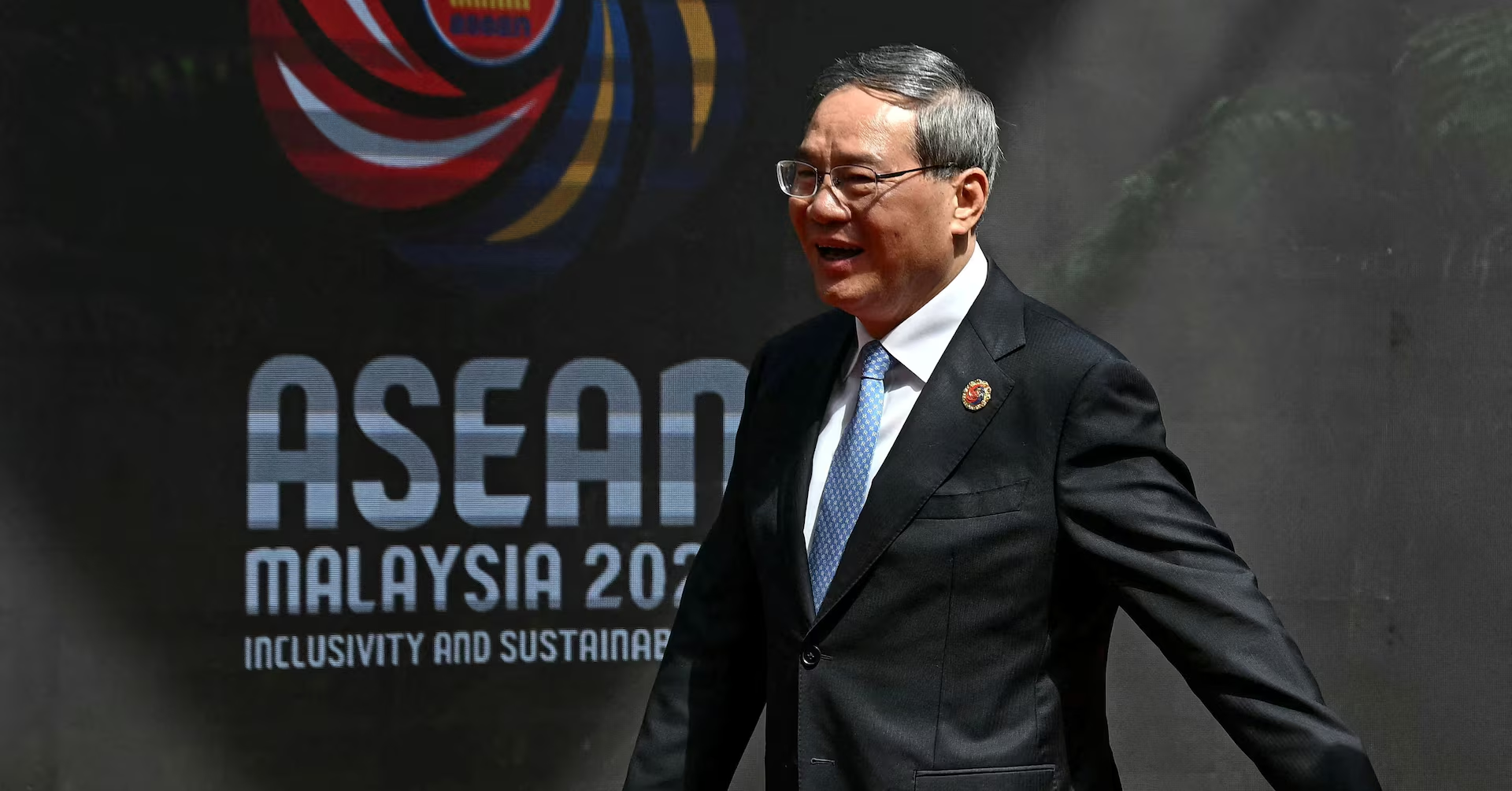
On 27 October 2025, China expressed its readiness to strengthen relations with Australia even as both countries navigate a landscape marked by rivalry and strategic competition. During a regional summit in Malaysia, Chinese Premier Li Qiang met Australian Prime Minister Anthony Albanese, where both leaders signaled a desire for a “stable and strategic partnership.”
Li told Albanese that Beijing was willing to “build a more predictable and enduring friendship” with Canberra, highlighting economic cooperation and regional peace as shared goals. Albanese, in response, described the relationship as one of “friends who can speak openly,” reaffirming his government’s intention to keep diplomatic communication channels open and active.
This goodwill comes despite several ongoing tensions — particularly in the South China Sea, the Pacific Islands, and global trade frameworks — where the two powers often find themselves on opposite sides.
Drivers Behind the Rapprochement
Economic Interdependence
The cornerstone of China–Australia relations remains trade. China is Australia’s largest export market, while Australia supplies key resources that power China’s economy, including iron ore, coal, and lithium. In return, Australian businesses rely heavily on the Chinese consumer market for sectors like education, agriculture, and tourism.
According to China Briefing, Australia’s exports to China rose notably in mid-2025, accompanied by renewed cooperation agreements in green energy, digital technology, and agricultural sustainability. Both governments appear to recognise that full economic decoupling would harm national interests, making pragmatic engagement the logical path forward.
Strategic Calculations and Regional Stability
For Beijing, maintaining a functioning relationship with Canberra helps reduce diplomatic risk and counters perceptions of Chinese isolation in the Indo-Pacific. Chinese officials have been expanding engagement with Pacific Island nations through trade, infrastructure, and security initiatives, and see stable ties with Australia as essential to regional equilibrium.
From Australia’s perspective, pragmatic diplomacy offers breathing space. While Canberra remains committed to its U.S. alliance and the AUKUS security pact, it understands that dialogue with Beijing can lower the temperature of regional tensions. “We have disagreements,” Albanese remarked, “but friends can discuss them frankly — and that’s exactly what we’re doing.”
Diplomatic Reset
The October meeting in Malaysia followed Albanese’s high-profile visit to China in July 2025, which marked a turning point after years of strain caused by trade disputes and political mistrust. During that trip, both sides reopened suspended trade dialogues, discussed easing restrictions on Australian exports such as barley and wine, and agreed to expand people-to-people exchanges.
The renewed diplomatic activity signals a broader reset — not a return to naïve optimism, but a conscious attempt to build a structured and managed relationship after years of hostility.
Flashpoints and Underlying Tensions
Military and Strategic Incidents
Recent friction was fueled by an incident in the South China Sea, where an Australian surveillance aircraft was reportedly approached by a Chinese fighter jet that released flares nearby. Canberra condemned the act as “unsafe and unprofessional,” while Beijing accused Australia of “provocative intrusion.”
Such episodes highlight how military competition increasingly overshadows economic cooperation. Both nations are seeking to assert presence in overlapping maritime zones, often accompanied by accusations of spying or interference.
Divergent Security Architectures
Australia’s role in AUKUS — a trilateral alliance with the United States and United Kingdom — remains a sore point for China. Beijing interprets it as a containment mechanism, while Canberra views it as essential for regional deterrence and technology sharing.
Meanwhile, Australia is expanding defence ties with Japan and the Philippines, a move Beijing regards warily. Balancing these commitments with an open relationship toward China represents one of Canberra’s most complex diplomatic challenges.
Economic and Regulatory Frictions
Even as trade resumes, old irritants linger. Australia has tightened foreign investment rules, citing national security — a move China perceives as discriminatory. Likewise, Beijing’s previous tariffs on Australian products such as wine, coal, and lobster cost exporters billions and eroded trust. Although several of these restrictions have been lifted, mutual suspicion persists.
Agreements and Signals from the Meeting
- China’s Premier Li Qiang emphasised his country’s intention to build a “more stable and strategic partnership.”
- Prime Minister Albanese reaffirmed Australia’s commitment to dialogue and mutual respect, noting that disagreements would not derail overall engagement.
- Both governments highlighted green economy, digital technology, and education as priority sectors for cooperation.
- Australia reiterated that it would address security concerns through conversation rather than confrontation.
- Each side acknowledged the existence of rivalry but agreed to manage competition constructively.
The tone was measured but optimistic — suggesting that both capitals see stability as the more rewarding route compared to renewed confrontation.
Why This Matters
For Australia
Economic stability depends heavily on access to Chinese markets. Disruptions in this trade flow directly affect jobs, mining revenue, and university enrolments. By keeping relations cordial, Canberra can also influence Beijing’s regional conduct through diplomacy rather than coercion.
At the same time, Australia must juggle alliance expectations and domestic scepticism. Any appearance of being overly conciliatory to China could invite political backlash at home, especially given public concern about espionage and foreign interference.
For China
Re-engagement with Australia supports Beijing’s image as a responsible global player and mitigates U.S.-led efforts to isolate it diplomatically. China also benefits economically from Australian resource reliability — particularly as it faces Western restrictions on technology imports and supply chain diversification challenges.
For the Region
The relationship serves as a bellwether for Indo-Pacific stability. If China and Australia can maintain cooperation despite rivalry, it may set a precedent for managing other great-power competitions in the region. Conversely, renewed confrontation would likely embolden hardliners and fuel militarisation across Southeast Asia.
Challenges and Caveats Ahead
- Recurring Military Encounters: Any miscalculation in contested waters or airspace could trigger diplomatic crises.
- Alliance Friction: Australia’s deepening ties with the U.S., Japan, and others under security frameworks will continue to test Chinese patience.
- Economic Uncertainty: Investors on both sides remain wary, and new regulatory barriers could emerge if trust erodes.
- Domestic Pressures: Nationalistic sentiment within both countries might limit leaders’ room to compromise.
- Pacific Competition: Canberra’s outreach to Pacific Island nations — partly to counter China’s influence — may reintroduce tension.
- Human Rights Concerns: Australian criticism of China’s internal policies, such as in Xinjiang or Hong Kong, could resurface as flashpoints.
While both sides appear motivated to maintain calm, the underlying mistrust remains deeply embedded.
Indicators to Watch
- The frequency of high-level dialogues and trade missions.
- Progress on lifting remaining tariffs and import restrictions.
- Establishment of military communication hotlines to prevent accidents.
- Coordination or rivalry in Pacific Island development projects.
- Shifts in Australian parliamentary or media narratives on China.
- Expansion of cooperation in green technology, AI, and infrastructure.
These markers will determine whether the relationship enters a sustainable phase or slides back into confrontation.
Implications and Conclusion
China and Australia have embarked on what analysts describe as “managed coexistence.” The two nations acknowledge deep strategic differences but are choosing engagement over estrangement. Albanese’s diplomacy reflects realism: Australia must cooperate economically while defending its sovereignty and alliances. For China, a calmer relationship with Canberra helps steady its regional strategy and secure resource flows.
Still, competition is structural, not situational. Military tension in the South China Sea, influence battles in the Pacific, and ideological divergence will persist. What matters now is whether both countries can keep these differences from dominating the agenda.
If dialogue mechanisms hold and trade continues to normalise, the partnership could evolve into a model of pragmatic coexistence within a contested region. But should another military incident, trade dispute, or political scandal flare up, the fragile stability could easily unravel.
Ultimately, the meeting between Li Qiang and Albanese underscored one clear truth: cooperation and competition will coexist in the modern Indo-Pacific. The challenge for both sides is learning how to balance them — not through rhetoric, but through steady, transparent, and predictable diplomacy.