What’s Been Agreed
Signing and Purpose
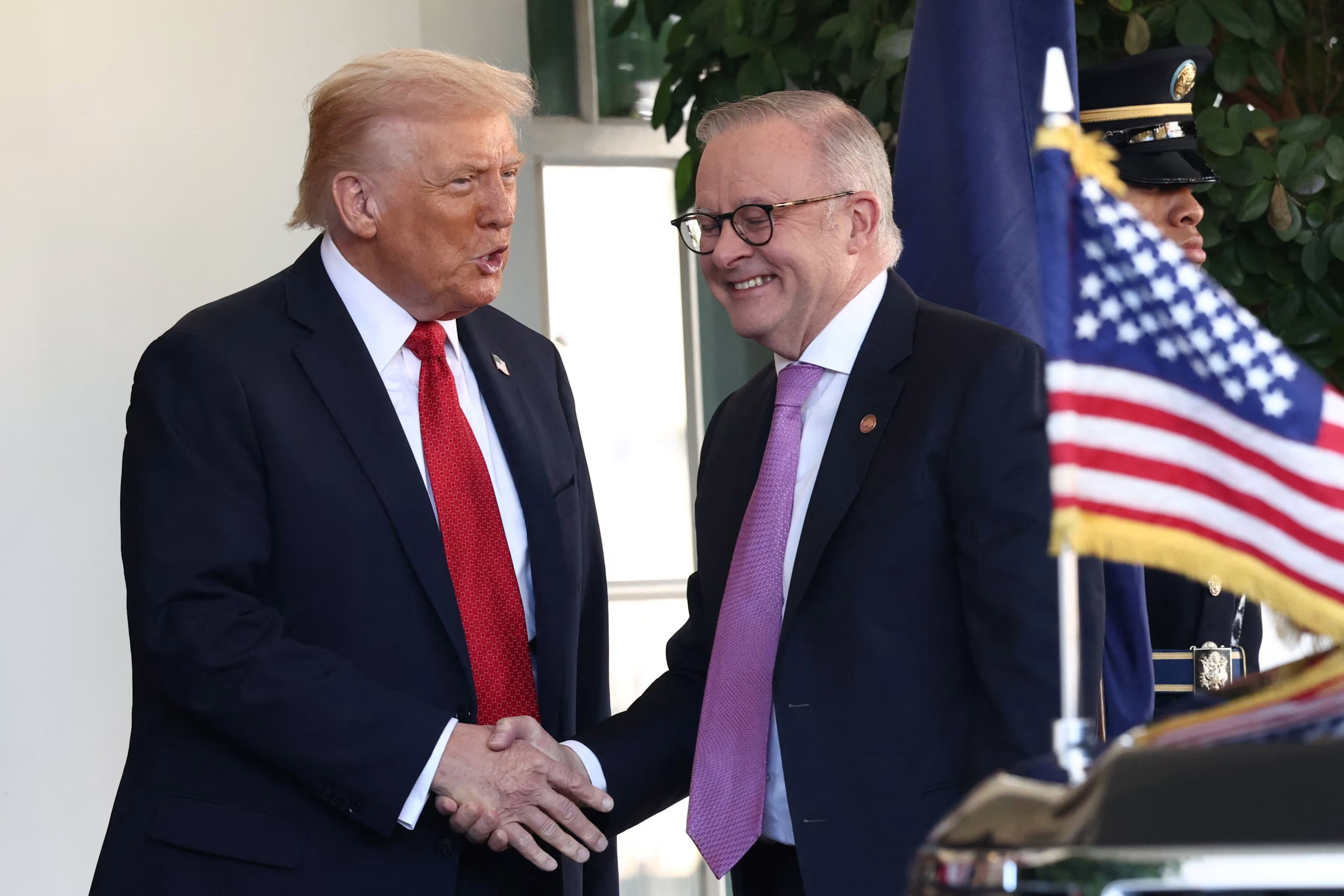
On October 20–21, 2025, U.S. President Donald Trump and Australian Prime Minister Anthony Albanese signed a major framework agreement on critical minerals. These minerals are essential for clean energy, advanced manufacturing, defense systems, and high-tech supply chains.
Key Investment Figures
- Total potential value: up to US $8.5 billion in projects under the agreement.
- Immediate commitment: at least US $3 billion to be invested within six months.
- U.S. Export-Import Bank involvement: issued letters of interest worth US $2.2 billion for companies such as Arafura Rare Earths and Sunrise Energy Metals.
Flagship Projects
Australia will provide up to AUS $200 million in concessional equity for the refinery. Both countries may also secure future offtake rights — agreements to buy specific volumes from selected projects.
One major project is a gallium-refinery in Western Australia, backed by Alcoa and its Japanese partner JAGA. The facility could supply 10 percent of global gallium output.
Strategic Objective
The core goal is to reduce dependence on China’s dominance in refining and processing critical minerals.
Diplomatic and Market Reactions
Australian officials described the deal as taking relations “to the next level.” U.S. leaders framed it as a strategic push to diversify supply chains away from China.
Stock markets reacted quickly — critical-minerals companies surged in value following the announcement.
Why This Matters
1. Strategic and Economic Importance
Critical minerals — such as rare earths, gallium, cobalt, lithium, nickel, graphite, and antimony — power the technologies of the future. These include electric vehicles, semiconductors, wind turbines, and defense systems.
China currently dominates refining and processing, even when raw materials come from elsewhere. Western economies now see this dependence as a strategic risk, prompting policy responses from the U.S., Australia, and their allies.
2. Shared Goals of the Partnership
Through this framework, both nations aim to:
- Secure reliable access to critical minerals outside China.
- Build supply-chain integrity across allied nations.
- Develop complete production chains — from mining to processing and manufacturing.
- Send a strong market signal that Western alliances are committed to reshaping global mineral supply.
Prime Minister Albanese emphasized the plan is not “just about digging things up” but also about investment across the full value chain.
Timing and Geopolitical Context
1. A Strategic Response to China
China recently imposed tighter export controls on rare-earth magnets and related technologies, showing its readiness to use mineral dominance as leverage.
The U.S.–Australia deal serves as a hedge against such moves, ensuring steady supply even if China limits exports.
2. Connection with AUKUS
The agreement complements other strategic initiatives, such as the AUKUS submarine pact between the U.S., Australia, and the U.K. Together, these efforts strengthen their Indo-Pacific security and economic posture.
Commercial Implications
1. Boost for Industry and Investment
The deal lowers risk for miners and processors through government-backed financing. This could spur new mines, refineries, and processing facilities.
Shares of Arafura Rare Earths and other firms rose sharply after the announcement.
2. Moving Beyond Extraction
The partnership encourages value-addition within Australia, shifting from simple mining to refining and manufacturing.
For Australia, this means higher industrial returns.
For the U.S., it ensures secure access to essential inputs from trusted allies.
Why the Gap With China Remains Large
1. China’s Massive Head Start
China has spent decades investing in refining, magnets, and materials. It now controls 70–90 percent of global rare-earth processing.
An analyst summarized:
“China has almost a 40-year head start. It will take decades for others to catch up.”
2. Time-Lag in Building Capacity
Developing new mines and refineries takes years, often a decade or more. Environmental approvals, infrastructure, and skilled labour all slow progress.
As TIME reported:
“The framework may take years to yield tangible results.”
3. High Costs and Tough Economics
Western projects face stricter environmental standards and higher costs, unlike China’s low-cost, large-scale operations.
To compete, new supply chains will require subsidies or long-term offtake guarantees.
4. Limited Scope of One Deal
“Critical minerals” cover a wide range of elements. One framework cannot fix supply gaps in all categories — from lithium to antimony.
Australia has rich reserves, but high processing costs and price swings have slowed investment.
5. China’s Ongoing Leverage
China’s refining dominance still gives it power to control prices and exports, or even undercut competitors. Until other nations build full chains, this risk remains.
6. Scale and Non-Binding Limits
While the deal’s headline value is US $8.5 billion, only part of it is firm. Some projects may never materialize.
Analysts call it a “first step, not a finish line.”
Implications for Africa and Kenya
1. New Investment Opportunities
Western investors seeking alternatives to China may expand into Africa, Latin America, and Central Asia. This could bring infrastructure, mining partnerships, and funding to resource-rich African nations.
2. Building Value Chains Locally
African governments may push for local refining and manufacturing rather than exporting raw ore.
3. Meeting ESG Standards
To attract funding, new projects must meet environmental, social, and governance (ESG) criteria — increasing costs but improving sustainability.
4. Geopolitical Balance
Mineral-rich African countries could face stronger competition between Western and Chinese investors. Strategic neutrality may become vital.
5. Diversifying Dependence
For Kenya, the lesson is diversification — avoid relying on one market or refinery. The global minerals race highlights the need for multiple trade partners.
Risks and Considerations
- Execution risk: possible delays, overruns, or environmental issues.
- Market risk: price crashes or technology shifts (like new battery chemistries).
- China’s reaction: potential export tightening or price undercutting.
- Reliance on Australia: it cannot meet global demand alone.
- Political tension: tighter U.S.–Australia alignment may provoke Chinese retaliation.
Bottom Line
The U.S.–Australia critical-minerals framework marks an important strategic milestone. It strengthens allied supply chains, promotes economic independence, and signals long-term resolve to reduce reliance on China.
Yet, closing the gap with China will take many years. The deal begins a long effort to rebuild industrial capacity and cooperation among friendly nations.
For Kenya and Africa, this global shift offers opportunity and challenge — attracting investors, demanding higher standards, and reshaping the mineral trade landscape for the next generation.