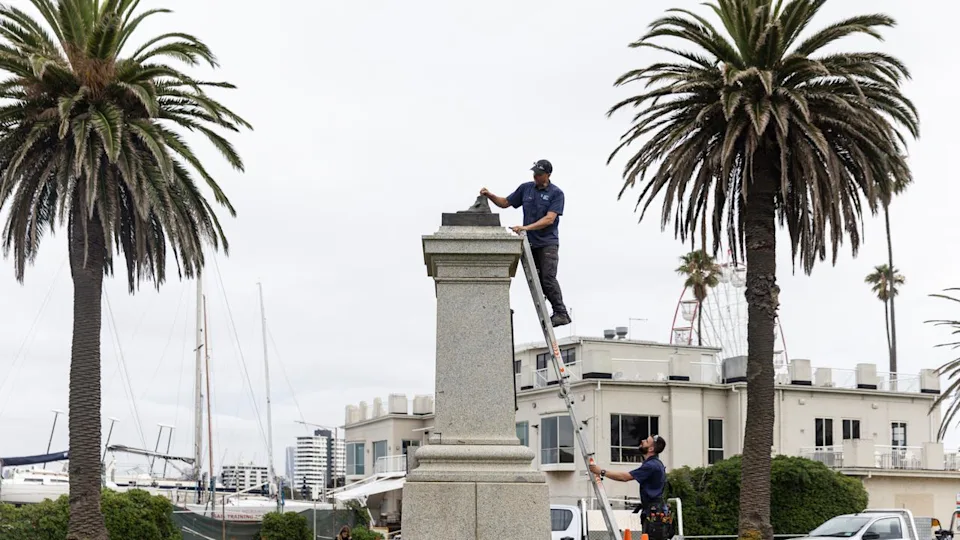
Two historic monuments in Melbourne were defaced in a targeted attack just ahead of Australia Day, a national day of mourning and celebration. The vandalism occurred between Wednesday night and Thursday morning, with the words “Death to ‘Australia’” spray-painted on one of the statues, marking a disturbing act of destruction in the lead-up to the country’s commemorative day.
The two monuments targeted were Melbourne’s Pioneer monument, erected in 1871, and the nearby Separation Memorial, which was established in 1950. The Pioneer monument, a five-meter tall sandstone obelisk, marks the city’s first burial site and was severely damaged, with heavy machinery believed to have been used in an attempt to tear it down before the ruins were further vandalized. The Separation Memorial, commemorating the founding of the Victorian colony a century earlier, also bore defacing markings.
Melbourne’s Lord Mayor Condemns the Attack
Melbourne’s Lord Mayor, Nicholas Reece, expressed outrage at the attack, calling it “absolutely despicable” and denouncing the vandals as “absolute idiots” for failing to understand the historical significance of the monuments they targeted. Speaking to reporters outside St Paul’s Cathedral on Thursday, Reece said, “We are up for a debate about the future of statues and memorials in Melbourne, but tearing them down through acts of vandalism will not be accepted.”
The vandalism occurred despite increased efforts to protect the city’s monuments, including the installation of cameras and fences, ahead of Australia Day. Reece further emphasized that the act of destruction would not go unpunished, adding, “We cannot tolerate this behaviour, we cannot reward this behaviour.”
Ongoing Debate on Colonial Monuments
The defacement of these monuments is part of a broader, ongoing debate over the presence of colonial statues and memorials in Australian cities. In recent years, Australia has seen a growing movement to reevaluate its colonial history and the figures commemorated in public spaces. Vandals have targeted several monuments, particularly those associated with the country’s colonial past.
In 2025, a statue of Captain Cook at the entrance of Edinburgh Gardens in Fitzroy North was toppled during the January long weekend, leading the City of Yarra to vote in May 2025 to remove the statue due to the high costs of repair and repeated vandalism.
Despite the controversy surrounding these memorials, Lord Mayor Reece stated that the Flagstaff Gardens monuments would be reinstated, though the cost of repairs remains uncertain. The city has vowed to restore the damaged sites, underscoring that acts of vandalism will not deter efforts to preserve Melbourne’s heritage.
Hate Crime Concerns and Government Response
The timing of the vandalism is especially significant, coinciding with the national day of mourning for the victims of the Bondi Beach terror attack, which claimed 15 lives in December 2025. The words and symbols used in the defacement of the monuments may constitute a hate crime under Victoria’s anti-vilification laws, according to Reece. Premier Jacinta Allan also condemned the attack, describing it as “a disgrace” and emphasizing that it introduced hate and destruction during a day meant to foster love and unity.
Allan called for the perpetrators to face the full force of the law, stressing that such actions would not be tolerated by the government or the people of Victoria. The police have cordoned off the area as they continue their investigation into the incident, with hopes of identifying the individuals responsible for the defacement.
Broader Implications for Australia’s Colonial Legacy
The vandalism of the Flagstaff Gardens monuments has sparked a renewed conversation about Australia’s colonial history and how the nation should address its past. While some see these statues and memorials as symbols of historical significance, others view them as reminders of a painful legacy tied to colonialism, oppression, and the mistreatment of Indigenous communities.
In recent years, Australia has seen a wave of public debates and protests over the removal of statues and monuments associated with colonial figures. This act of vandalism highlights the tension between preserving history and acknowledging the harmful impact that some historical figures and symbols may have on marginalized communities.
A Divided Debate
The defacing of Melbourne’s Pioneer monument and Separation Memorial serves as a reminder of the ongoing division in Australian society over how to handle its colonial past. While some demand the removal of statues and memorials that celebrate controversial figures, others argue that these monuments should be preserved as part of Australia’s shared history. The debate continues to evolve, and incidents like this one will likely fuel further discussion about the future of monuments in Australia. For now, the police investigation and the public’s response will shape the course of this ongoing national conversation.