The World Economic Forum in Davos made history in 2026, but not in the way its organizers envisioned. The elite gathering became a backdrop for raw geopolitical thuggery and frenzied diplomacy. Consequently, the event may be remembered as the moment the eight-decade-old transatlantic alliance definitively unraveled. The immediate crisis centered on U.S. President Donald Trump’s threat to impose tariffs over Greenland. This showdown pushed other key themes, like artificial intelligence and climate change, to the sidelines. The week culminated in a vague deal but exposed a profound rupture in the global order.
Canadian Prime Minister Mark Carney captured the moment in a powerful speech. He declared the world is in “the midst of a rupture, not a transition.” This sentiment echoed through closed-door debates about trade, capital flows, and technology. The Greenland crisis confirmed European leaders must now confront a future outside the American security umbrella. While markets rallied after a deal was announced, the underlying trust within NATO was deeply damaged. Davos 2026 therefore marked a pivotal shift from dialogue to discord among global elites.
The Greenland Crisis and NATO’s Unraveling
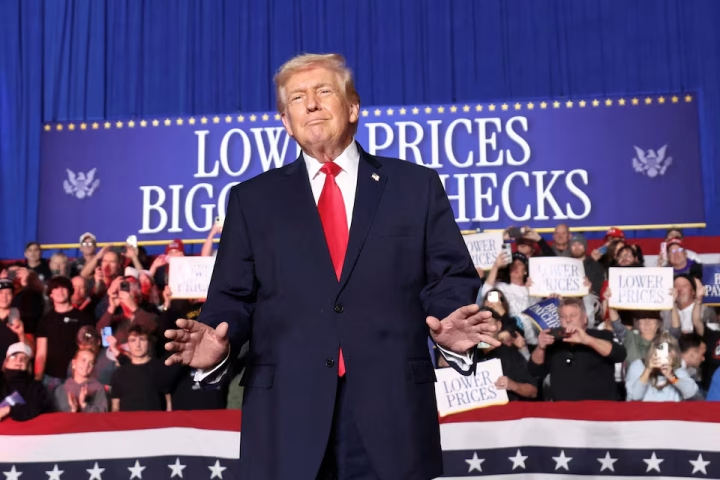
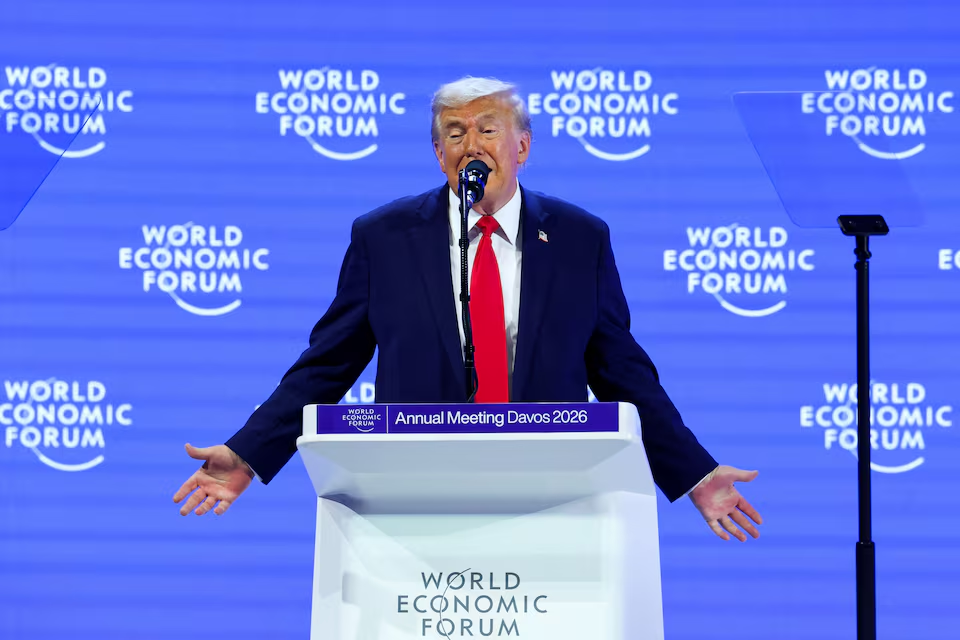
The crisis began with President Trump’s threat to slap fresh tariffs on European nations. His demand: allow the United States to purchase Greenland. This ultimatum sparked protests and urgent discussions about European retaliation. Trump’s Wednesday speech in Davos was characteristically blunt. He pledged not to take the territory by force but issued a mafia-like warning: “You can say yes and we will be very appreciative. Or you can say no and we will remember.”
Hours later, Trump declared a deal with NATO Secretary General Mark Rutte. The agreement involved vague promises of Arctic security cooperation. Markets rallied on the news, but the damage was done. European leaders saw that American security guarantees are now purely transactional. Military analysts had already questioned whether the U.S. would defend a NATO member under Russian threat. The Greenland crisis made those doubts overwhelming. The alliance now urgently requires alternative arrangements.
Shifting Financial Flows and Rising Protectionism
The geopolitical rupture is triggering significant financial realignment. Behind closed doors, financiers discussed diversifying away from the United States. Investors are seeking fresh opportunities in Europe, the Middle East, and Asia. Large institutions that previously reduced Chinese holdings are cautiously rebuilding exposure. This shift reflects a broader loss of faith in U.S.-centric globalization.
Financial protectionism is also rising. One private equity executive revealed a Scandinavian institution refused to invest in funds managed by an American firm. Denmark’s AkademikerPension announced it was selling its $100 million portfolio of U.S. Treasury bonds. U.S. Treasury Secretary Scott Bessent dismissed the move and Denmark as “irrelevant.” These incidents, though small, signal a fragmentation of the global financial system. Capital flows are becoming tools of geopolitical alignment, not just economic optimization.
AI’s Affordability Challenge and ‘Pilot Purgatory’
Artificial intelligence was a major topic, though overshadowed by Greenland. The discussion highlighted a key challenge: affordability. The Trump administration’s embrace of AI must confront the enormous costs of development and deployment. Meanwhile, corporate adoption is hitting a snag. Consultants described a state of “pilot purgatory,” where companies struggle to move beyond small-scale experiments.
Tech leaders like Jensen Huang and Satya Nadella had little new to report. Consumer adoption is strong; Meta reported over a billion monthly users for its AI tools. However, converting pilot projects into profitable, scaled applications remains elusive. This gap between hype and operational reality defines the current AI moment. The technology is revolutionary, but its economic payoff is not yet guaranteed for many businesses.
Climate Focus Fades to ‘Resilience’
Discussions on climate change, once a Davos cornerstone, were notably muted. Companies and consultants adopted new language, focusing on “resilience.” This term serves as cover for continued sustainability talks but reflects a sobering shift. The debate is no longer primarily about limiting global warming. It is now about coping with a hotter planet. This pragmatic, if grim, reframing shows how immediate geopolitical and economic crises have displaced long-term environmental planning.
A Lesson in Elite Gullibility and Disinformation
Davos provided an ironic lesson in how disinformation spreads, even among elites. Ahead of Trump’s arrival, a false story circulated widely. Many executives claimed mobile signals in the resort would be scrambled for security. They cited organizers and shared WhatsApp messages as proof. The story was completely bogus. Reporters streamed Trump’s speech on full 5G signal on the main street.
This episode underscored a key point. The Davos crowd often frets about technology-fueled disinformation. Yet its members proved just as susceptible to baseless rumors as anyone else. It highlighted that critical thinking is scarce, regardless of education or status. In an age of rupture, the ability to discern truth from fiction remains a universal challenge.
The Lasting Legacy of a Historic Week
Davos 2026 will be remembered as a turning point. It showcased the collapse of polite diplomatic fiction. The transatlantic alliance is now openly transactional and fragile. Financial globalization is fragmenting along geopolitical lines. AI development is hitting cost and implementation walls. Climate action is being downgraded to adaptation.
The “Spirit of Dialogue” banner hung over a forum where ultimatums, not discussions, dominated. The relief that followed Trump’s deal is likely temporary. The underlying forces of nationalism, protectionism, and strategic rivalry are stronger than ever. Future historians may look back at this week as the moment the old order’s demise became unmistakable to the very elites who benefited from it.