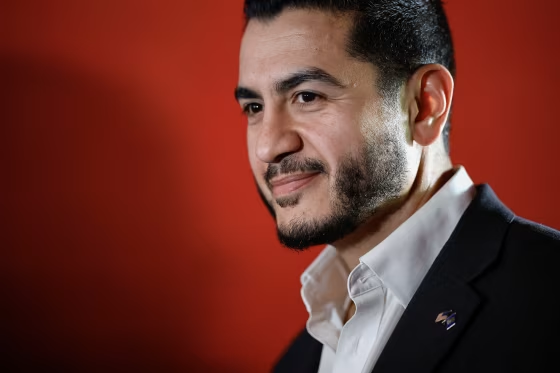
Abdul El-Sayed has won Michigan’s 2026 US Senate race, defeating Republican Mike Rogers, NBC News projects. The result makes the former public health official the first Muslim elected to the US Senate.
El-Sayed, 42, will succeed retiring Democratic Senator Gary Peters. His victory preserves a Democratic-held seat in a closely watched battleground and extends Republicans’ unsuccessful run in Michigan Senate elections, stretching back to their last victory in 1994. NBC Los Angeles
The Associated Press also called the race for El-Sayed, according to Michigan public broadcaster WKAR. The projections precede the completion of official certification procedures. WKAR Public Media
Michigan Senate election result at a glance
| Detail | Result |
|---|---|
| Projected winner | Abdul El-Sayed |
| Party | Democratic |
| Republican opponent | Mike Rogers |
| Seat being contested | Open seat held by retiring Senator Gary Peters |
| Effect on party control | Democratic hold |
| Historic milestone | First Muslim elected to the US Senate |
| Election date | November 3, 2026 |
The distinction between a hold and a gain matters. Michigan’s result prevented a Republican pickup; it did not flip a Republican-held seat.
Who is Abdul El-Sayed?
El-Sayed is an epidemiologist and former public health official associated with the Democratic Party’s progressive wing.
His campaign drew support from Senator Bernie Sanders and Representative Alexandria Ocasio-Cortez. He centred his platform on expanding healthcare coverage through Medicare for All, reducing the influence of money in politics and addressing household financial pressures.
The Michigan contest tested whether that platform could succeed in a competitive statewide election. El-Sayed’s victory gives progressives a prominent Senate win, although the result also came amid a broader favourable election environment for Democrats.
A campaign shaped by costs, healthcare and foreign policy
Economic concerns were central to the contest.
El-Sayed sought to connect his healthcare proposals and campaign-finance message to voters’ everyday expenses. Rogers, meanwhile, faced questions about President Donald Trump’s tariffs and the war in Iran.
In an interview cited by NBC News, Rogers distinguished his preference for targeted, temporary tariffs from the administration’s broader approach. The comments reflected the difficulty Republican candidates faced in balancing support for Trump with concerns about rising prices.
Foreign policy also exposed divisions within the Democratic Party. El-Sayed’s criticism of the Israeli government became a recurring campaign issue, drawing opposition from pro-Israel groups and some fellow Democrats.
Haley Stevens backed Rogers in a late campaign break
One of the race’s most unusual developments came when Democratic Representative Haley Stevens endorsed Rogers, despite previously pledging to support El-Sayed after losing the Democratic primary.
According to NBC News, Stevens linked her decision to disagreements over Israel and tensions with El-Sayed’s campaign.
Her endorsement gave Rogers support from a prominent Michigan Democrat in the final days of the race. It was not enough to prevent El-Sayed’s projected victory.
The episode highlighted the depth of disagreement within the party, even as Democratic voters ultimately kept the Senate seat in their column.
read Also: China Trade Booms as Focus Shifts to Expected Trump-Xi Summit
Religious attacks became a defining controversy
El-Sayed’s Muslim faith was repeatedly targeted during the campaign.
NBC News reported that Trump and other Republicans used rhetoric questioning his loyalty and associating him with extremism. El-Sayed rejected allegations that he had ties to the Muslim Brotherhood.
Those allegations should not be treated as established facts. Reuters reported that the claims lacked supporting evidence and that Democrats condemned the attacks as Islamophobic. reuters.com
In his remarks to supporters after the election, El-Sayed pushed back against the attacks and presented the outcome as a rejection of divisive campaigning.
His election marks a milestone for Muslim representation specifically in the Senate; Muslim Americans have previously served in the House of Representatives.
What the victory means for Michigan
El-Sayed will enter the Senate with a political profile distinct from that of the retiring Peters, bringing a more explicitly progressive healthcare and economic agenda.
His campaign promises will now face the practical demands of legislation: securing support from colleagues, negotiating priorities and working within the Senate’s procedures.
For Republicans, Rogers’ defeat means another missed opportunity to capture a Michigan Senate seat. For Democrats, retaining the seat strengthens their position after a contest that attracted national attention and substantial outside spending.
The next steps are completion of the election process and the transition to the new Congress in January 2027, when El-Sayed is expected to begin his Senate term.
Read Also: Point of Law Wins Melbourne Cup 2026 as Ciaron Maher Sweeps Top Three