The Indonesia Australia security pact marks a pivotal moment in regional diplomacy, as both nations formalize deeper defense cooperation to strengthen stability and collective security across the Indo-Pacific.
Strengthening Regional Security Through Renewed Cooperation
Indonesia and Australia have agreed to enhance defense coordination through a new Indonesia Australia security pact that elevates consultation mechanisms at both leadership and ministerial levels. This agreement aims to improve joint responses to regional threats and expand long-term security collaboration.
A Mutual Commitment to Stability
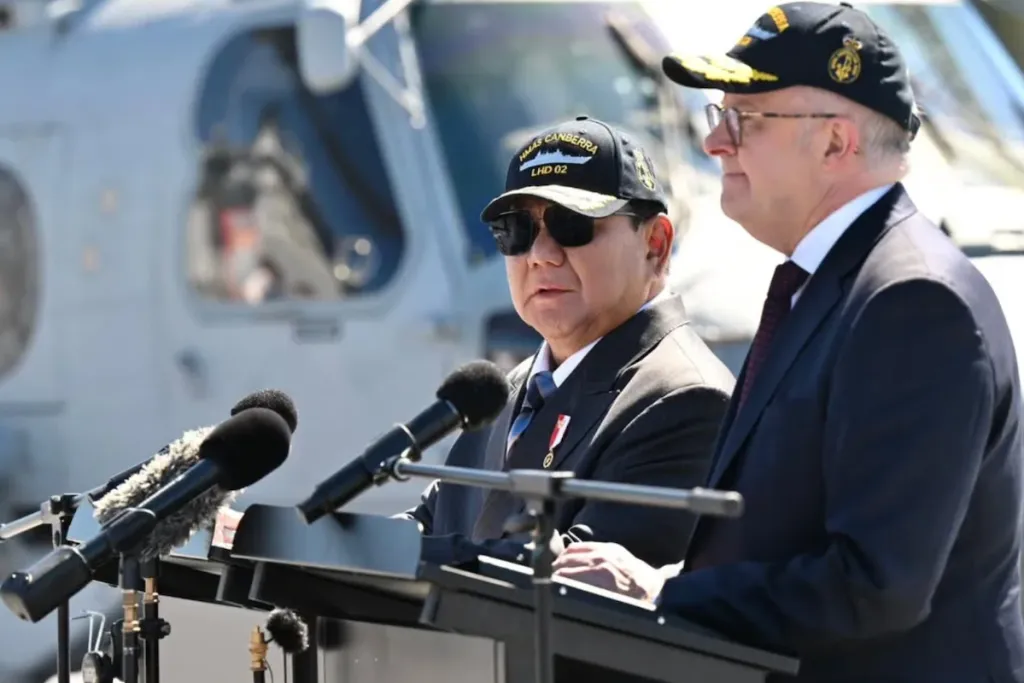
President Prabowo Subianto emphasized that the pact reflects a shared dedication to maintaining peace and stability. Speaking during a press conference streamed by the Presidential Secretariat, Prabowo highlighted the cultural and strategic value of strong neighborhood ties.
He stated that Indonesia and Australia, as close and directly adjacent countries, must work together to ensure the safety of their people. His remarks reinforced the idea that cooperation is essential during times of uncertainty or crisis.
Continuity From Previous Defense Frameworks
Prime Minister Anthony Albanese noted that the new Indonesia Australia security pact builds on the 2024 defense cooperation framework. He explained that both nations have agreed to consult and evaluate appropriate actions—whether taken individually or jointly—if threats arise.
Drawing From Decades of Collaboration
Albanese referenced the historical roots of this bilateral defense relationship, which dates back to the cooperation initiated by Prime Minister Paul Keating and President Soeharto nearly 30 years ago. This long-standing foundation demonstrates the consistency and depth of Indonesia–Australia ties.
Reinforcing the Lombok Treaty
A key aspect of the Indonesia Australia security pact is its reinforcement of the 2006 Lombok Treaty, a landmark agreement affirming respect for sovereignty, territorial integrity, and mutual security principles.
Strengthening Core Principles of Security
By reaffirming the Lombok Treaty, both nations signal their commitment to preventing regional instability and upholding international norms. Albanese highlighted that the new pact complements the treaty’s central objective: ensuring that Indonesia and Australia remain reliable partners in safeguarding their shared region.
A Partnership Anchored in Geography and Culture
President Prabowo emphasized that Indonesia and Australia’s physical proximity creates an intrinsic strategic partnership. In Indonesian culture, neighbors are the first to provide assistance during emergencies. By invoking this cultural analogy, Prabowo underscored the natural alignment between the two nations’ security interests.
Shared Interests in the Indo-Pacific
Both countries occupy critical positions in the Indo-Pacific, a region shaped by evolving geopolitical dynamics. Through the Indonesia Australia security pact, they are reinforcing their roles as stabilizing forces committed to addressing challenges such as territorial tensions, maritime security, and strategic competition.
What the Security Pact Means for the Future
The expanded cooperation framework signals long-term strategic alignment. The Indonesia Australia security pact is expected to pave the way for:
- More frequent high-level dialogues
- Joint military training and operations
- Coordinated responses to security threats
- Enhanced maritime and border security programs
- Broader collaboration on defense technology and intelligence sharing
This agreement deepens trust and signals readiness to confront future challenges together.
A Forward-Looking Step for Regional Safety
The renewed Indonesia Australia security pact is more than a diplomatic gesture—it is a forward-focused strategy designed to secure stability in an increasingly tense Indo-Pacific. By enhancing communication channels and reaffirming commitments embedded in historical agreements like the Lombok Treaty, Indonesia and Australia demonstrate their determination to act as responsible leaders in the region.
Their strengthened partnership is poised to shape regional security architecture for years to come, ensuring that both nations remain prepared, aligned, and committed to collective safety.