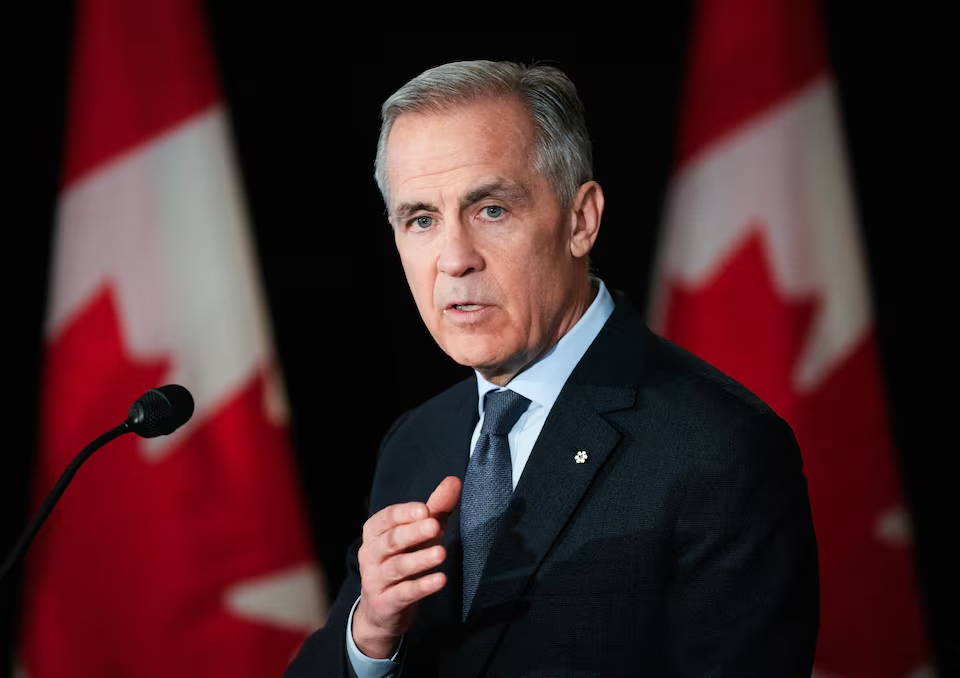
Canadian Prime Minister Mark Carney will visit Australia in March, Australian Prime Minister Anthony Albanese has announced. Carney is scheduled to address the Australian parliament during the visit. This diplomatic trip follows Carney’s notable speech at the World Economic Forum in Davos. In that address, he criticized powerful nations for weaponizing economic integration. He also presented Canada as a model for how “middle powers” can cooperate to avoid victimization. Consequently, the visit will likely focus on strengthening bilateral ties between the two allies.
Prime Minister Albanese publicly endorsed Carney’s Davos message. He stated he agreed with the Canadian leader’s critique of the shifting global order. The visit builds upon an agreement signed by the two nations in October. That pact aims to promote cooperation and trade in critical minerals. This sector is crucial for both countries’ economic and strategic interests. The March trip will provide an opportunity to advance this collaboration further.
Context of Carney’s Davos Speech and Albanese’s Endorsement
Mark Carney’s Davos speech framed the current geopolitical moment clearly. He declared the end of the old rules-based global order. He warned against powerful nations using tariffs as leverage and economic integration as a weapon. His comments were a clear critique of policies associated with U.S. President Donald Trump. Carney positioned Canada as a leading example for other “middle powers.” He suggested they must band together to avoid being marginalized by American or Chinese hegemony.
Anthony Albanese’s swift endorsement is significant. It signals Australia’s alignment with Canada’s diplomatic worldview. Both nations are close U.S. allies but seek to assert independent economic and foreign policy. Albanese’s agreement, broadcast on national television, confirms a shared perspective on navigating global fragmentation. This alignment sets a substantive agenda for the upcoming bilateral talks in March.
Deepening Critical Minerals Cooperation
The cornerstone of recent Canada-Australia relations is critical minerals. In October, the two countries signed a formal cooperation agreement. This pact aims to strengthen supply chains for minerals essential to clean energy and defense technologies. Both nations possess vast reserves of lithium, cobalt, rare earth elements, and nickel. Collaborating helps reduce dependence on dominant processors like China.
Carney’s visit will likely advance this partnership from agreement to action. Topics may include joint ventures, research sharing, and co-investment in processing facilities. Securing reliable, ethical supplies of these minerals is a top priority for Western economies. As geopolitical tensions rise, the Canada-Australia alliance becomes a strategic pillar for diversifying supply chains. The March meetings will be crucial for translating shared goals into concrete projects.
Strategic Implications for Middle Power Diplomacy
The scheduled visit underscores a growing “middle power” diplomatic bloc. Countries like Canada and Australia are leveraging their shared values and economic complementarity. They aim to exert influence collectively in a world dominated by U.S.-China rivalry. This partnership extends beyond minerals to include climate policy, democratic resilience, and trade diversification.
Carney’s address to parliament is a high-profile platform. It will allow him to articulate this vision directly to Australian lawmakers and the public. The gesture symbolizes mutual respect and a deepening partnership. It also sends a signal to other mid-sized democracies about the benefits of closer coordination. In an era of great power competition, middle power alliances are becoming increasingly vital for maintaining a balanced international system.
Potential Agenda and Outcomes for the March Visit
Beyond the parliamentary address, the visit will involve closed-door meetings. Leaders will discuss geopolitical coordination, likely including China’s regional influence and stability in the Indo-Pacific. Trade and investment facilitation will be another key topic, building on the critical minerals foundation. Climate and energy transition policies, where both countries are major resource exporters, will also feature.
A likely outcome is a joint statement or action plan. This document could outline specific initiatives for critical minerals development. It might also announce new dialogues on security or technology. The visit will also reinforce people-to-people ties through business and academic forums. Ultimately, the goal is to demonstrate that middle powers can be proactive architects of the new global order, not just passive subjects.
Broader Message Amid Global Tensions
Carney’s trip carries a message of solidarity and strategic autonomy. At a time when the U.S. is perceived as unpredictable under Trump, allies are strengthening bonds with each other. This is not about abandoning traditional alliances but about adding resilience through diversification. The Canada-Australia partnership exemplifies this pragmatic approach.
The visit will be closely watched in Washington and Beijing. It demonstrates that U.S. allies are capable of independent coalition-building. For China, it signals that resource-rich democracies are organizing to offer an alternative supply chain. For the international community, it offers a model of cooperative, rules-based engagement even as the old order fractures. March’s diplomatic exchange will be a significant step in defining this new middle power dynamic.